In Part One of this article we delved into the world of gravelly night riding - why you should try it, what things to think about and what to consider adding to your shopping list. In this part, we're going to focus on three handlebar-mounted lights from very different points on the price spectrum. We'll discuss the pros and cons of each and give you our testers' honest opinions of which one gives you the optimum set-up for your cash.
We’ve chosen three different lights from different ends of the market and to help showcase what’s on offer:
Moon Sport Titan Max 1700. £69
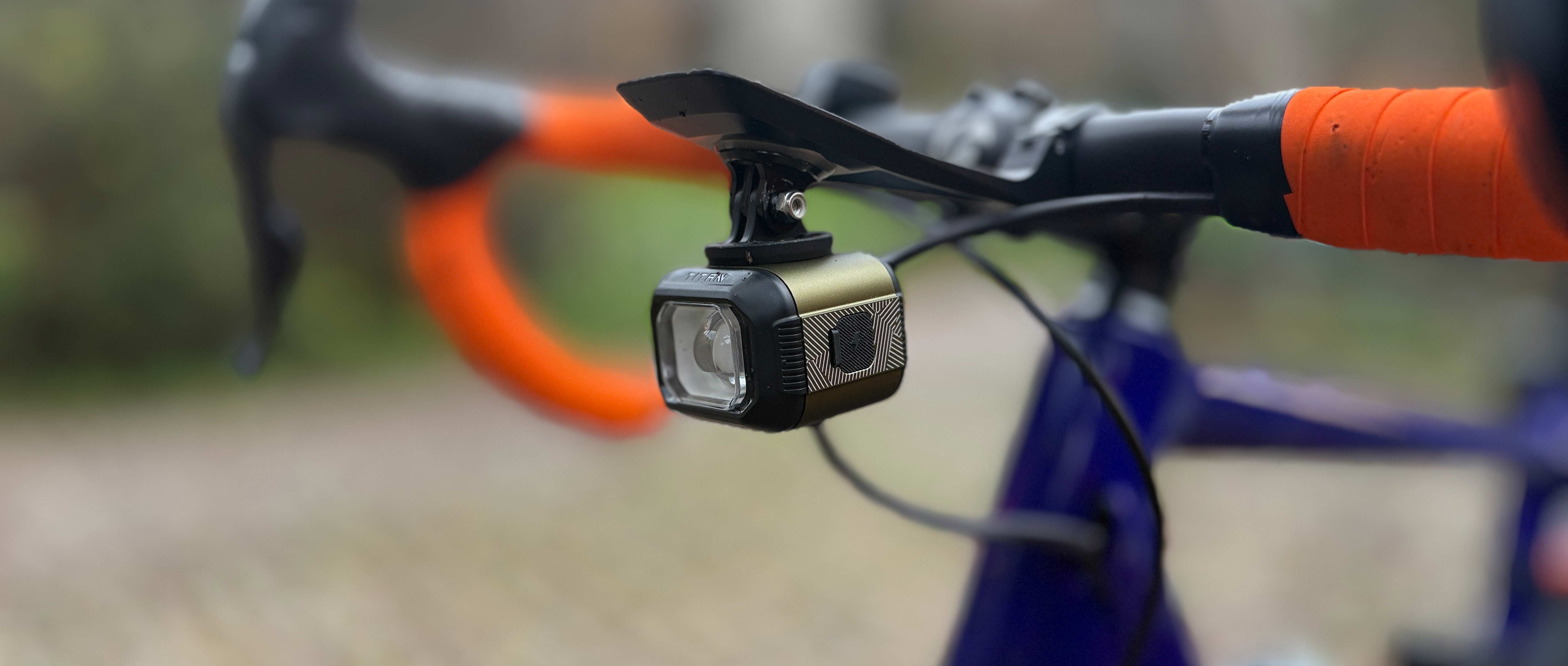
Moon Sports have a twenty year history of producing lights. Initially they were an Original Equipment Manufacturer, making lights for other companies, but now they design and sell lights under their own name. They are based in Hong Kong and their lights are manufactured in China. Their lights come with a two year warranty and the battery comes with a 120 day warranty. The Titan Max 1700 is the lightest of the three lights that we’ve chosen to feature at 153g.
The design of the Titan Max 1700 differs significantly from the other two lights in both its form factor, which is boxy, rather than cylindrical and the fact that it offers a wireless charging facility (to back-up the now ubiquitous USB C charging option). The light can be mounted both on top and below the handlebars by simply unscrewing two 1.5mm screws and switching the mounting plate from the top to the bottom (or vice versa). Despite the fact the Titan Max 1700 is significantly cheaper than the other two lights featured, it came with an impressively comprehensive set of accessories – a plastic ‘out-front’ combined computer/bike light mount (complete with adaptors for both Wahoo & Garmin computers), a set of 1.5/2/3mm Allen keys for setting up the light/computer mount, a quick-release GoPro light mount, adaptors for different handlebar diameters and a wireless remote control (complete with coin cell battery). The fit and the function of the included out front mount weren’t as good as it could have been. Although the Titan Max 1700 was supplied with a variety of rubber adaptors for different diameter handlebars, none of them offered a snug enough fit to prevent the mount from rotating around the handlebars. The mount is also surprisingly flexible with noticeable movement present once a computer and the light were fitted. In the end, we erred on the side of caution and used an existing metal out front mount, rather than risking Titan’s own.
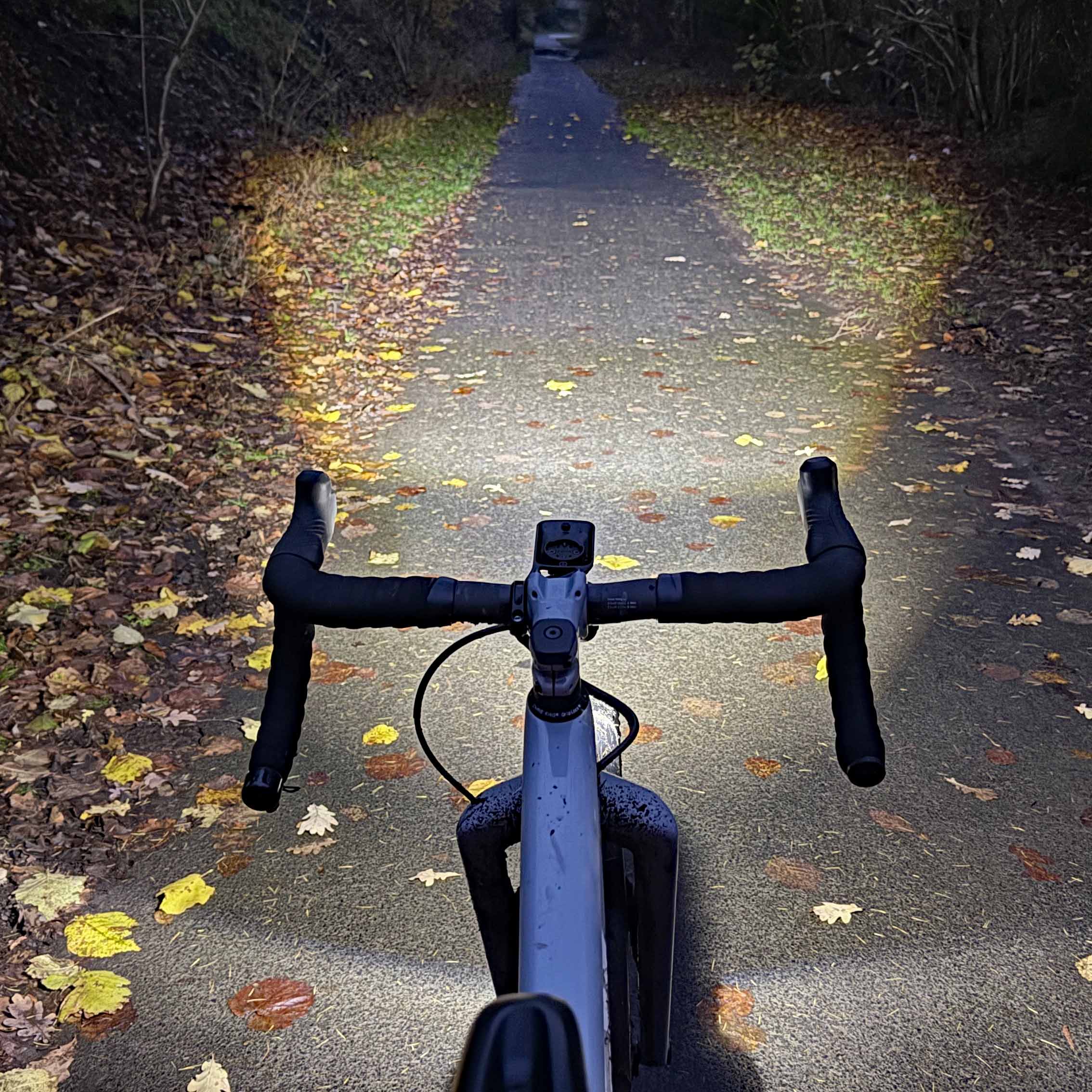
No official information is available for the battery capacity of the Titan Max 1700, but based on one of the on-line reviews that we could find, the capacity is stated as 3600 mAh. This is the smallest of the three lights that we have featured, which keeps the weight down, but also reduces the burn time in the highest power output mode to two hours. The Titan Max 1700 offers very different functionality to the other two lights in that it offers a high beam (described by Moon as ‘highway beam’) and low beam (described by Moon as ‘city beam’) options. The City (low) beam option meets with Germany’s strict STVZO bicycle lighting regulations which tries to illuminate reduce glare to oncoming cyclists while still safely illuminating the road (or gravel trail) in front of the user. Highway beam/city beam can be selected either by using the included Bluetooth remote control or by pressing the soft-touch button on the side of the light body.
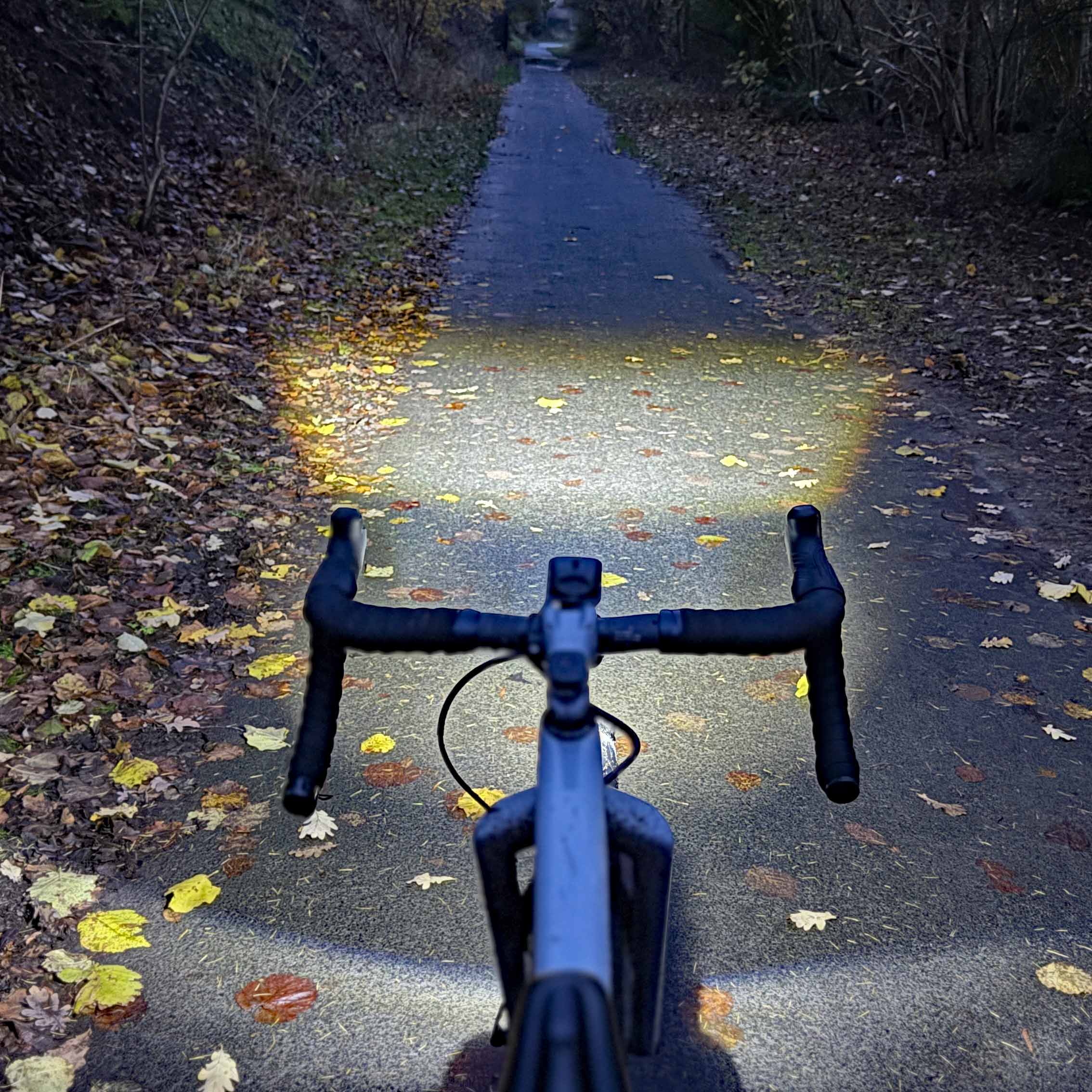
''City' beam
'Highway' beam
In use, the Titan Max 1700 produces a dramatically different beam pattern to the other two lights. Rather than producing a typically rounded light beam, the Titan Max 1700 produces two separate but overlapping beams. At the top is a trapezoidal shaped beam. If you imagine taking a standard light beam and then projecting it through a letter-box shaped template, you’ve got a good idea of how it looks and feels. If you switch from highway beam to city beam, the shape of the letter box narrows significantly, so this is best reserved for on-road riding only. Closer to the rider is a boxier shaped beam – this offers good coverage of the ground immediately in front of the rider as well as some limited peripheral coverage.
There are a total of nine different options available when you consider highway beam, city beam, fixed and flashing options. Within the highway beam option, the rider can select two power output levels – 1700 lumens and 1000 lumens, which give maximum burn times of two hours and three hours respectively. It’s also possible to select the light output for each of the different pre-programmed settings through Moon’s Variable Lumen System. While this can offer additional battery life, we suspect that when riding away-from-the-road, most gravel riders will restrict their to use to highway beam in the two different power outputs and the other options will generally be ignored.
"The Titan Max 1700 offers some unique features with the remote control, ‘dippable’ main beam and the wireless charging option."
Overall, the Titan Max 1700 offers some unique features with the remote control, ‘dippable’ main beam and the wireless charging option. The relatively small battery limits the burn time at the brightest light setting and for this reason alone, we wouldn’t recommend you use it as your sole light source. However, if you have an existing helmet-mounted light to complement it (or can justify buying a secondary light source), then the Titan Max 1700 offers good value for money and it makes a great “introduction to gravel night riding” light.
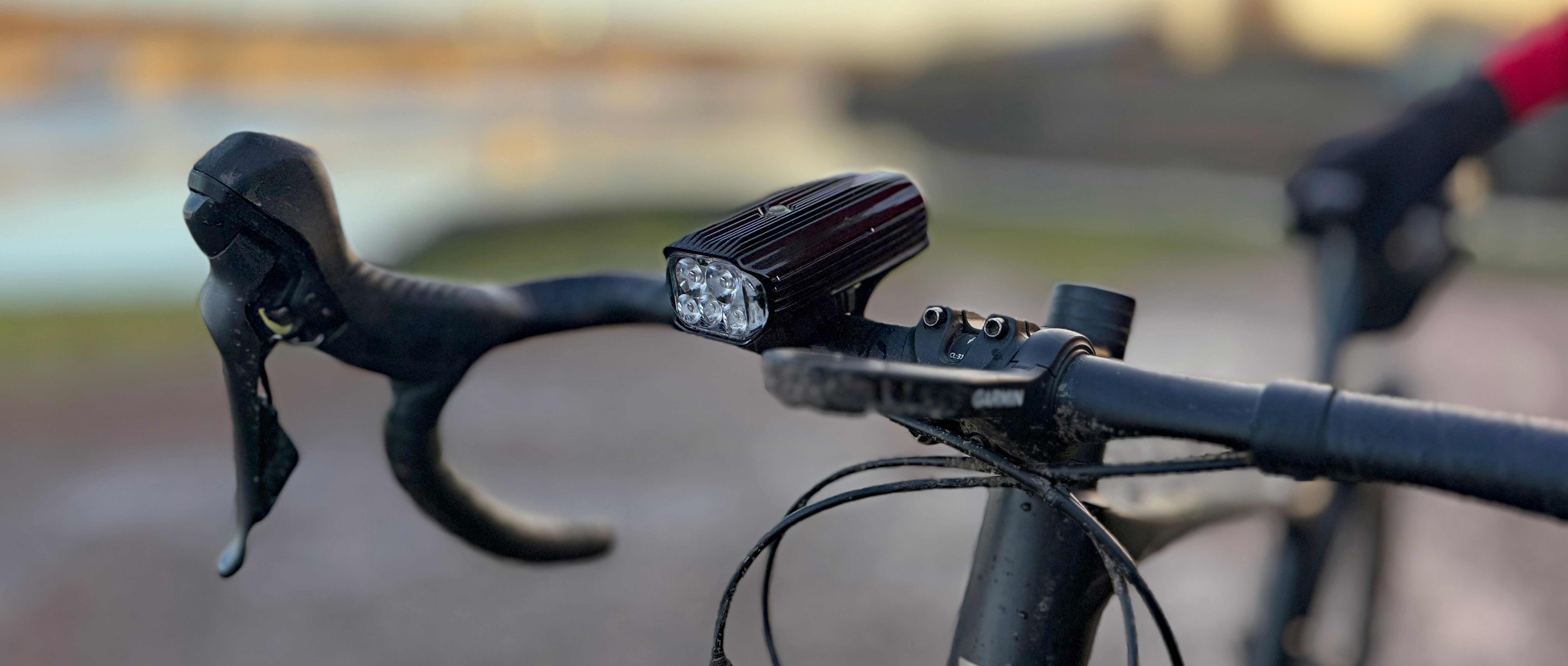
Lezyne started making LED lights in 2011 and offer a wide range from basic/commuter models up to this top-of-the-range MegaDrive 2400+ Their lights are designed in the USA and manufactured in Taiwan. They offer a two year warranty on the lights and a six month warranty on the battery itself. The MegaDrive 2400 is the heaviest of the three lights that we’re featuring (326g), but that’s because the battery is the biggest - 9600mAh. The light is machined from aluminium and comes with in-built cooling fins and heat sinks which should prevent any heat issues even when continuously running the light on full power. The MegaDrive 2400+ is rated to a waterproofness level of IPX7 which means it can withstand being submerged in 1m of water for up to 30 minutes. The unit is charged via a rear-mounted USB C socket, covered in a rubber bung. The light is compatible with external powerbanks and can function as a powerbank itself. Lezyne have focussed the design on simplicity (which helps keep the price down), so there is no external display screen or ability to use a remote switch.
The (included) strong rubber mounting band gives a speedy and secure fix – holding the light true while taking on obstacles including a short flight of stone steps and hopping a fallen tree. There’s an adaptor included for round handlebars which is easily removable for larger diameter or oval-section bars. The light can be rotated to give easier access to fix the strap closed or to line the beam up when using the light on swept-back drop bars. Lezyne also offer a separate GoPro-style mount for anyone wanting additional mount point options. When it comes to the function of the light, our tester particularly liked the “Race Mode” setting – this option provides a straightforward toggle between the 700 Lumen power output for the easier trails and the full 2400 Lumen Over-drive setting when the pace goes up or the riding gets more twisty and technical. To access the Goldilocks 1500 Lumens/4-hour runtime option, which falls between the two, you have to scroll through the four flashing and four constant light settings.
"Unless you’re heading into the twistiest, rootiest (crossing into MTB terrain) trails, the bar-mounted Mega Drive 2400+ should be sufficient on its own."
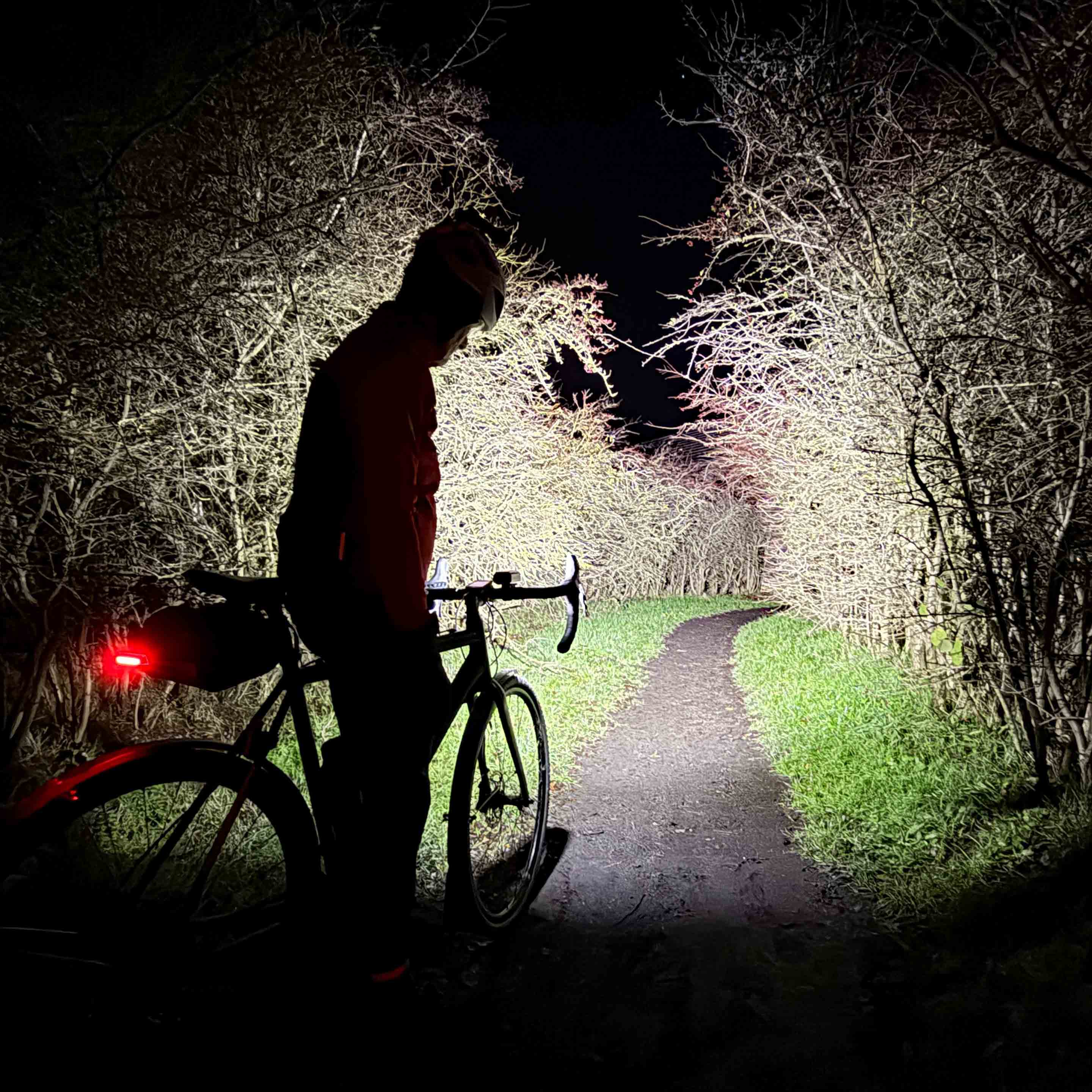
Lezyne Megadrive 2400+ on high power (2400 lumens)
The lower power settings provide a good spread of natural feeling, quite white, light. At times though, the spread did throw shadows of the shifter hoods onto the trail edges, but once you’ve identified the dark shapes in your peripheral vision you can focus on the trail ahead. In the more powerful settings (1500 and 2400 lumens) the way ahead is bright and clear and unless you’re heading into the twistiest, rootiest (crossing into MTB terrain) trails, the bar-mounted Mega Drive 2400+ should be sufficient on its own. The added-flexibility provided by pairing it up with a “see-round-corners” helmet-mounted partner light means all bases would be covered.
Exposure Race 19 £295
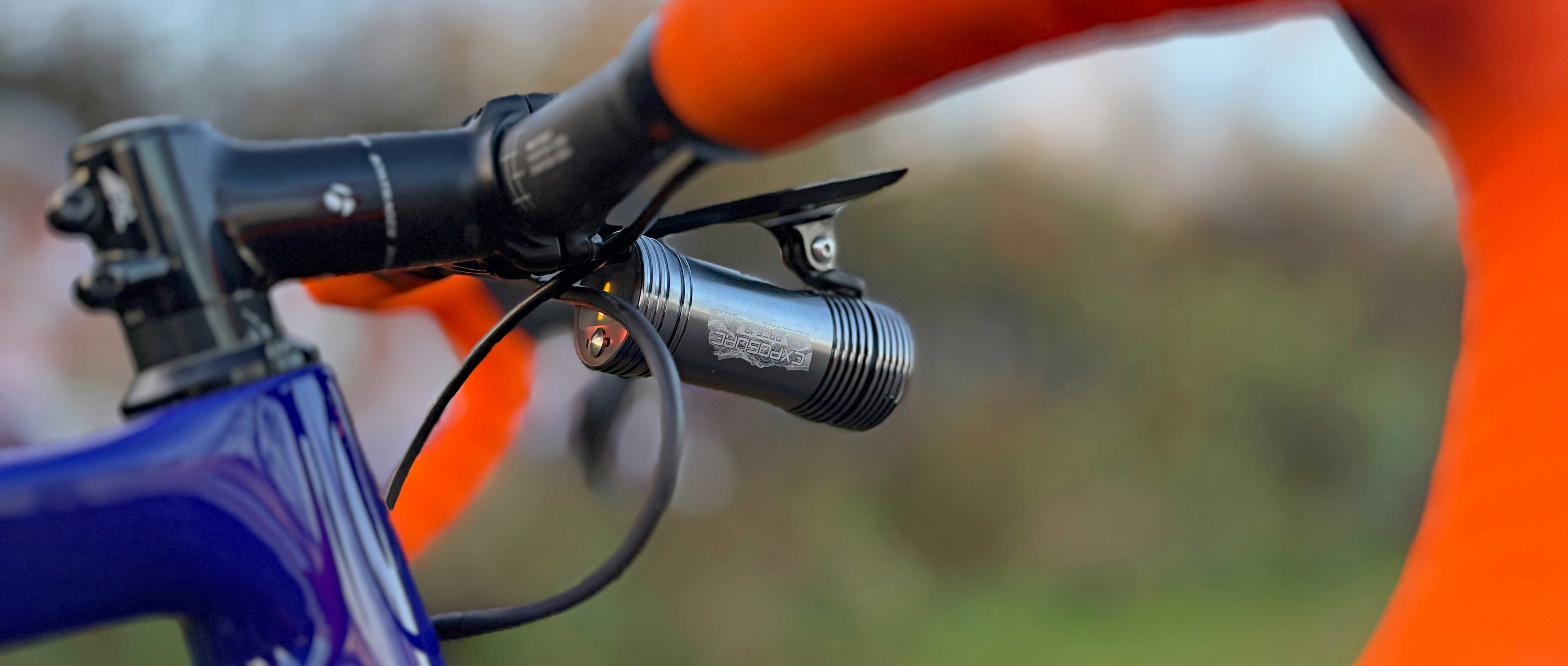
Exposure have been making bike lights for more than 20 years. Manufactured in the UK and complete with a minimum two year warranty (and a stellar workshop service backup), Exposure lights are widely considered to be the top of the pile when it comes to quality. You pay for it though – their best lights are £300 and upwards, so they’re aimed at the frequent fliers of the nightriding world. The Race 19 weighs 195g and is machined from 6063 aluminium. With a cylindrical design, cooling fins and machined vent holes in the front, the Race 19 is a striking looking light. Charging is via an inbuilt USB C port in the rear. The port is covered with a precisely fitting rubber bung and the light is rated to IP67 waterproof standard, so it can withstand being submerged in 1m of water for 30 minutes and is fully sealed against dust ingress too. The light comes with a 8000 mAh Li-ion battery and can be charged completely in just over two hours.
"With a minimum two year warranty (and a stellar workshop service backup), Exposure lights are widely considered to be the top of the pile when it comes to quality."
Unlike their range of small-bodied lights, the Race 19 model comes with Exposure’s own cleat mount system and an included-in-the-price forged alloy handlebar bracket. For anyone who is using a non-round handlebar, you can change the standard cleat for a Go-Pro style mount which lets you use any aftermarket ‘out-front’ computer mount, or Exposure’s own stem faceplate mount. The benefit of this is that it centralises the light on the bars (which seems to give a better pool of light) and also reduces cockpit clutter to a minimum. Just remember to add a drop of thread lock to the light bracket before attaching it to the light body. The light can be charged from a powerbank and when put into powerbank mode, it can be used to charge other devices too.
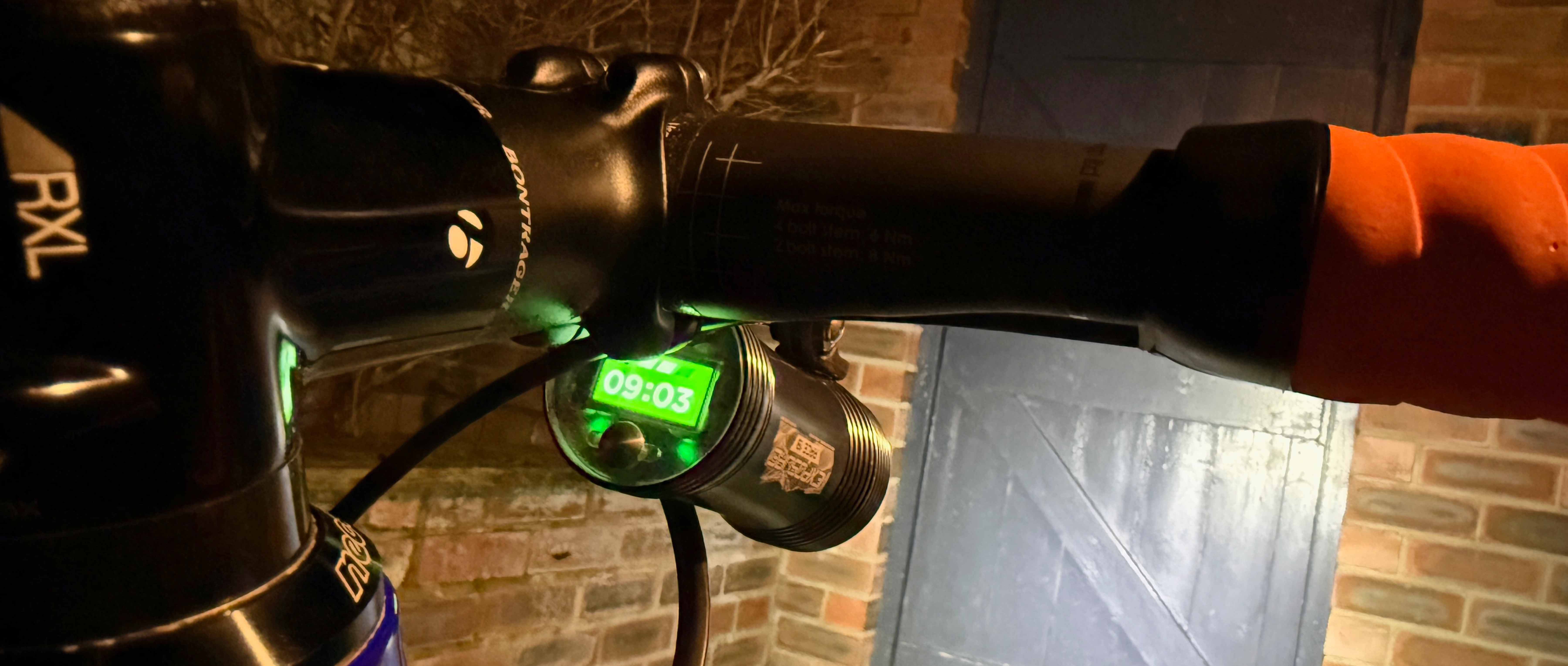
By default, the Race 19 offers a choice of three Optimised Mode Selector (OMS) power outputs – High (1226 lumens), Medium (588 lumens) and Low (314 lumens) which give 3, 6 and 12 hours of battery burn time respectively. Switching between modes takes a tap on the stainless steel function button. You can also choose to have a two-mode set-up - high power (1800 lumens) and low power (588 lumens). This would give you 2 hours or 6 hours of battery life respectively. The large colour screen on the back of the light displays which of the three modes you are in and what the remaining burn time in hours & minutes. The display auto-rotates so the information should be readable no matter which way up you mount it. If you choose to mount the light on an ‘out front’ mount the screen is likely to be obscured, but the function button should still be accessible for changing power modes.
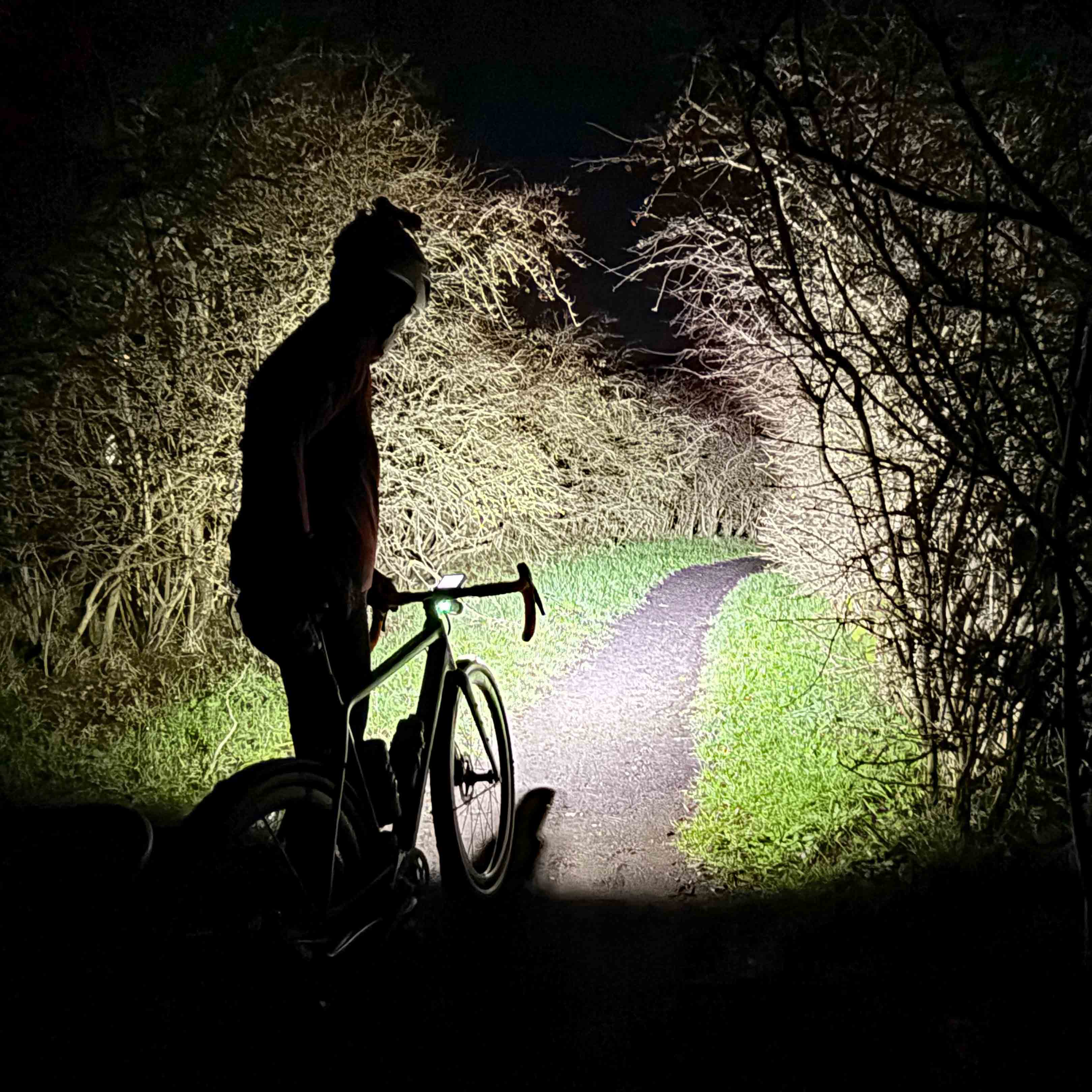
Exposure Race 19 in 1226 lumens power mode
As well as the manual OMS power settings, the Race 19 comes with Exposure’s Reflex 2.0 technology which “uses thermistors, 3D gyros and 3D accelerometers built into the light to adapt the brightness automatically based upon air flow, gradient and cornering forces. This gives the light the ability to flare up for fast rough descents giving you more light when you need it most and then dim down for slow climbs, prolonging your burn time.” Depending on where you are riding, this sounds like an incredible use of technology. Unfortunately Exposure also say “Do not use Reflex when riding on the road as the output can dazzle other road users” which means for gravel riders, where our routes tend to interlace sections of trail with sections of paved road, the Reflex 2.0 system isn’t really relevant. You could always manually switch between Reflex mode and manual mode, but if you’re doing that you might as well just stick in manual mode and change the brightness of the light depending on what trail you are riding.
In our test rides, we found that OMS mode 5 (the default out of the box) offered the perfect combination of brightness choices. Although you could choose to go full-blast with the 1800 lumen option, we tended to run the Race19 in either 1226 or 588 lumen mode instead. 1226 lumens might sound a little underwhelming, but it’s a perfect example of quality over quantity and the pool of light was crystal clear and faded gently around the margins. For the majority of gravel riding, the lower power/longer burn time option was perfect, particularly if you pair the Race 19 with a helmet light.
The Exposure Race 19 was the most expensive option of the three lights we tested, but the quality shone through (ha ha.) Not only did the Race 19 offer an impressive range of manual and automatic light settings, the warranty and service back-up of Exposure help go a long way to justifying the price tag. We know of riders still regularly using Exposure lights that are more than a decade old without any problems - if you worked out the value for money in terms of cost-per-ride, suddenly the headline price seems much more reasonable!
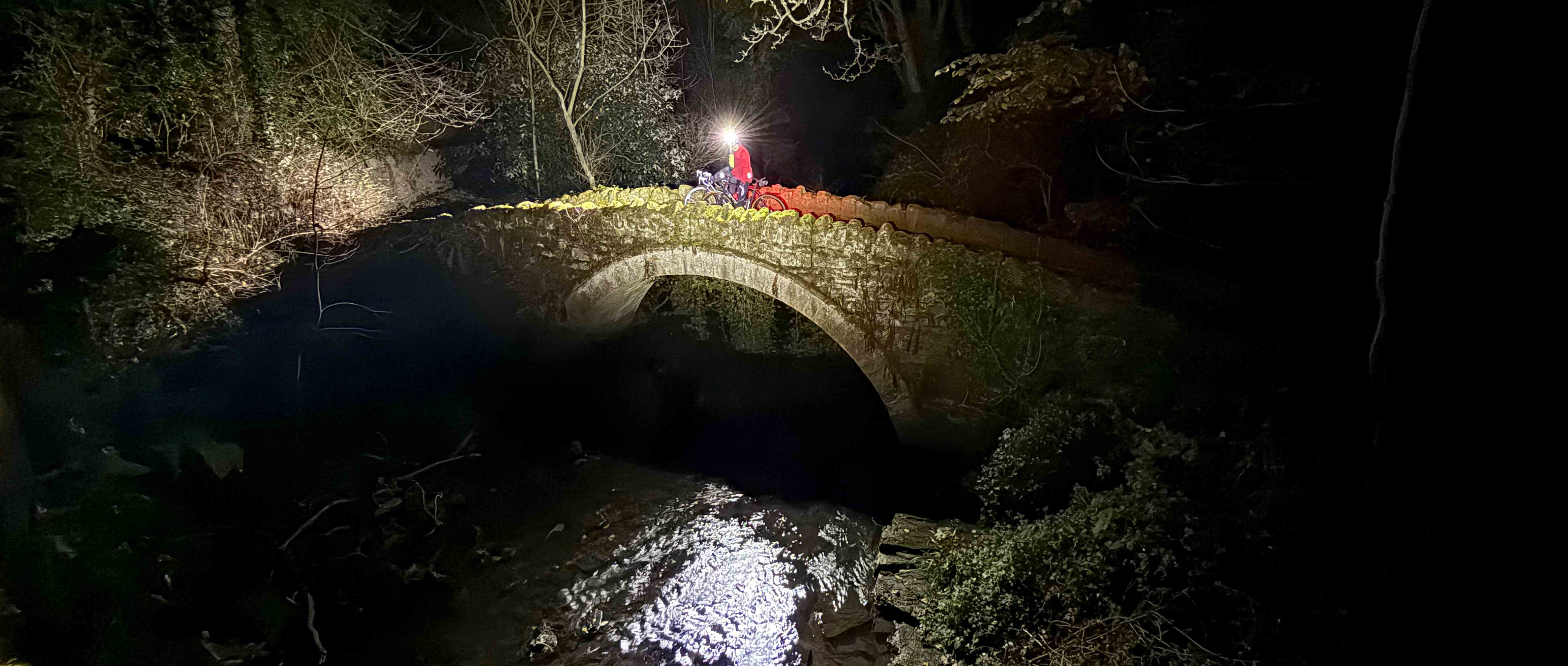
Heading out at night on your gravel bike will open up a range of new experiences to you. With the reduction in vision comes an increase in your other perceptive skills and you should find the buzz from the experience is even better than daylight riding. All you need is a set of lights and a sense of adventure and you're all set. See you out there on the trail. Just don't forget to dip your headlight if we're riding towards you....