The realisation that you’ve got a mid-ride puncture is one of the worst feelings. It’s almost guaranteed to be cold/raining/windy, so the less time you spend faffing about re-inflating your tyre, the better. Until fairly recently, a trailside puncture would have meant digging out a hand pump or a CO2 cartridge. The hand pump was quite slow and the CO2 cartridge was an environmental disaster, neither of which is ideal. So enter, left of stage, the electric mini pump – the perfect solution for trailside repairs? TruFlo have recently launched their first model and Graham Hatt has been testing it out.
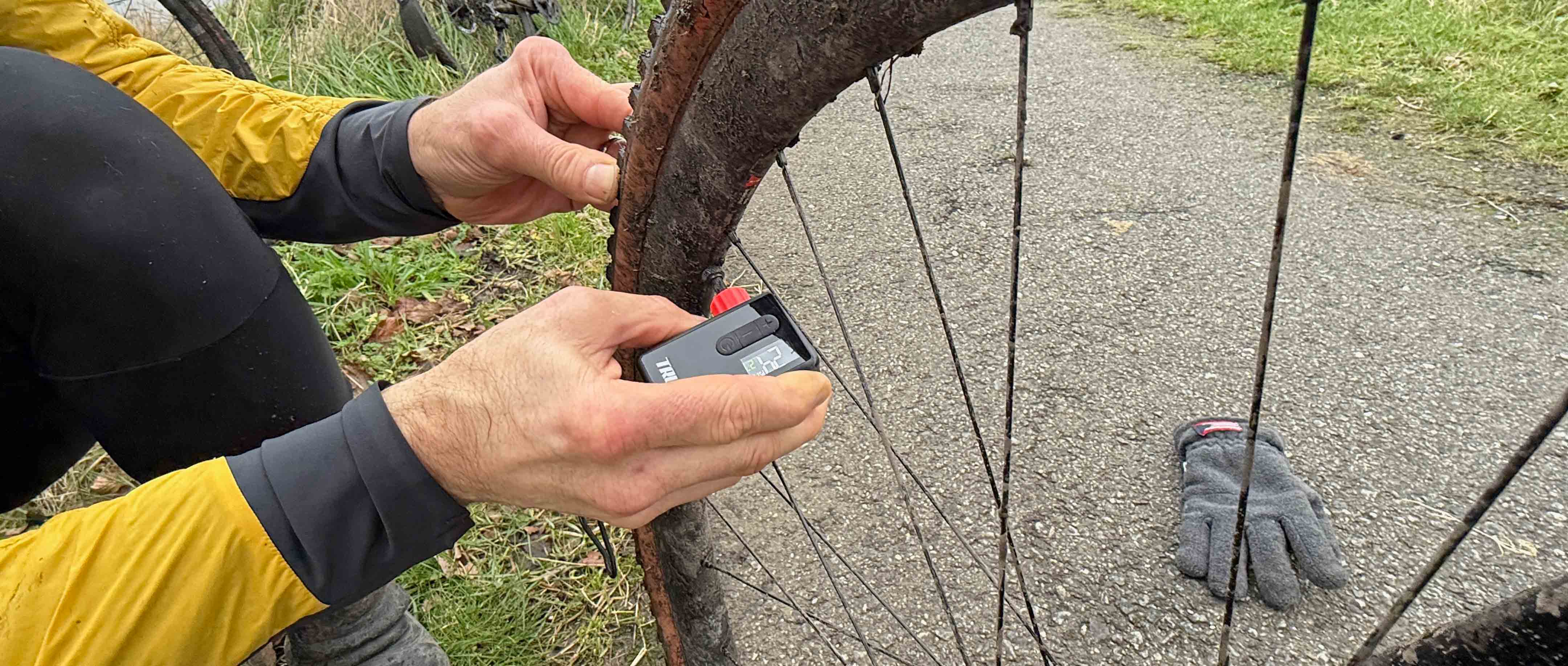
I’ve been really looking forward to trying out an electric mini pump since they first appeared in the UK market. Initially, they were quite expensive, but you can now pick them up for less than £50, which makes them a much more attractive proposition. I was offered a TruFlo Electron Compact Electric Pump to try out and jumped at the chance. For me, there was only one significant measure of success for this pump; it had to make my current conventional pump (which I always carry strapped to the outside of my bike) redundant. This meant that, not only did it have to work, but it needed to have sufficient battery charge to not give me ‘range anxiety’ after I’d used it.
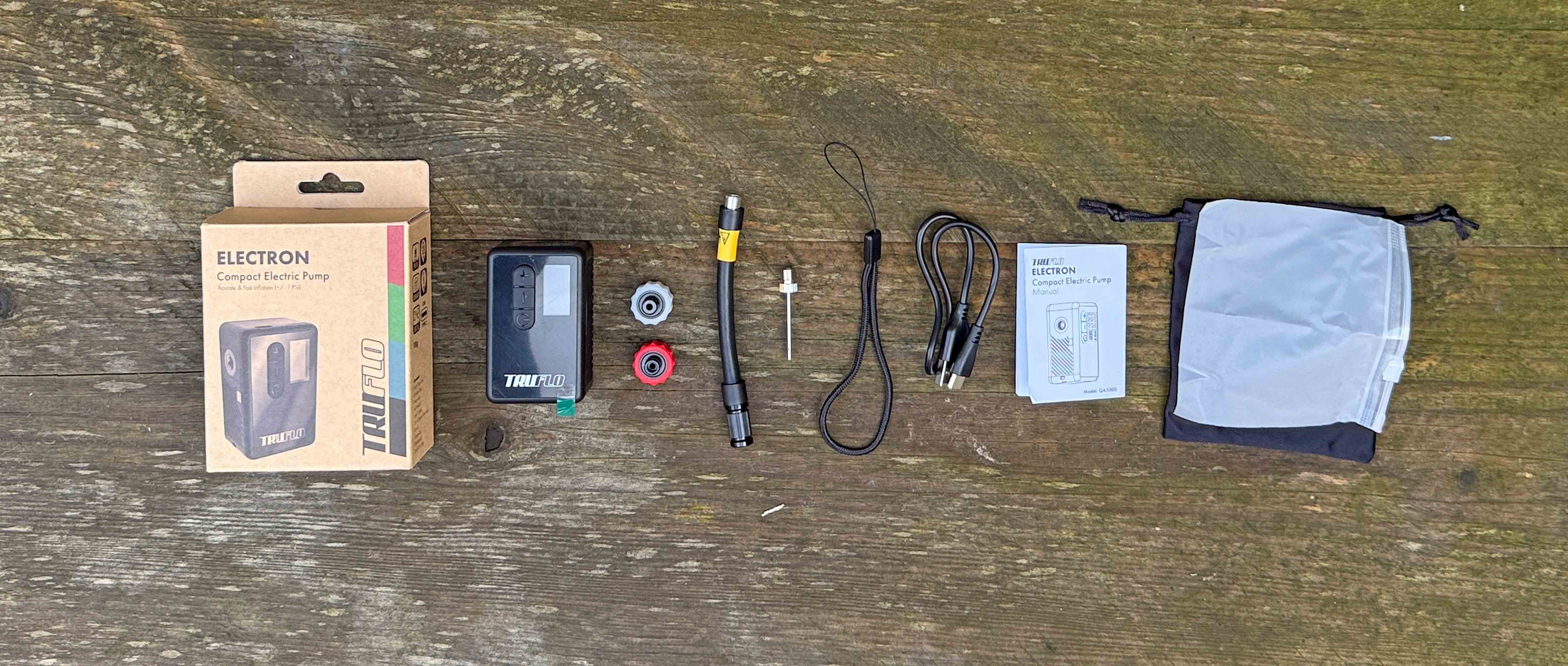
The pump measures 72mm x 45mm x 35mm (without a nozzle) and weighs 127g (with the presta nozzle fitted). My current manually operated Lezyne high-volume pump is 134g, by comparison. The TruFlo comes with a plastic ziplock bag (which must be used to protect it from moisture) and a black fabric outer bag. During the test period, I didn’t use the included Schrader valve adapter, flexible hose or ball needle adapter. The body of the pump has a clear LCD screen, which displays current pressure, target pressure, unit of measure (bar or psi) and state of charge. There are three buttons on the unit - you set the target pressure using the ‘+’ and ‘-’ buttons and start the pump with the power button. The instructions tell you that you toggle between bar and psi by double-tapping the ‘+’ button and turn the LED light on and off by double-tapping the ‘-‘ button, but it’s actually the other way around. It’s quite easy to accidentally change from psi and bar if you press the ‘+’ button too quickly when setting the target pressure so I learnt to do this more slowly. Also, on several occasions, as I’ve been carrying it from the house to the garage, I’ve inadvertently switched it on, which has given me a bit of a fright. I’ve learnt to carry it more carefully now! The TruFlo pump fits easily into a jersey pocket or my top tube bag and it also fits neatly inside the down tube storage area of a new gravel bike I’m currently putting together.
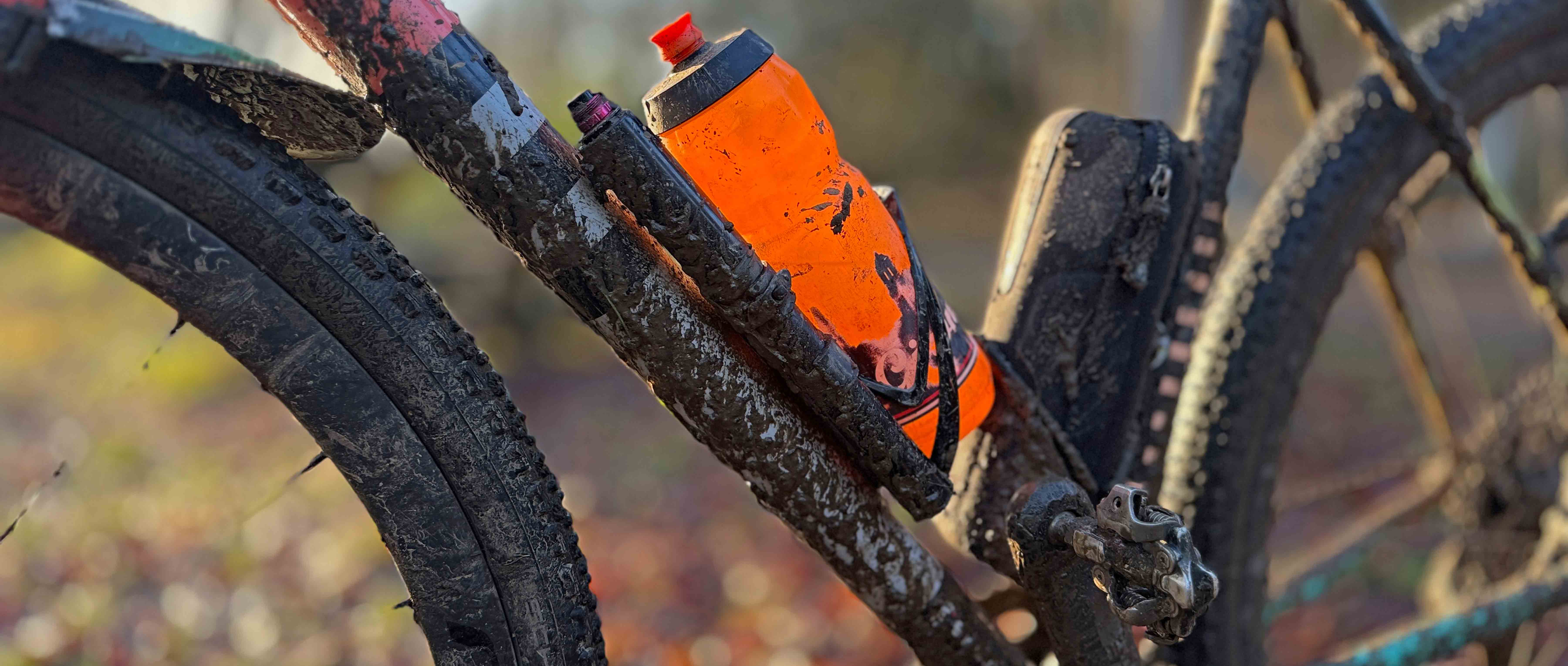
I’ve carried the TruFlo AND my conventional pump on several long, muddy gravel rides in recent weeks. But, I’ve also carried out some tests in the garage to figure out exactly how long the battery will last, and (SPOILER ALERT) I’m now convinced that I can leave my old pump at home.
I decided to test the pump’s battery longevity by inflating completely empty gravel bike and mountain bike tyres as many times as I could before the (fully charged) battery ran out. For each test, I removed and cleaned the valve core and valve stem and I tested the pressure after each inflation with a Schwalbe digital pressure gauge, which measures to 0.1 psi precision. The gravel tyre was a Schwalbe G One Ultrabite 700 x 45mm and the mountain bike tyre was a Schwalbe Nobby Nic 29” x 2.4”, both set up tubeless and both fitted with Vittoria tyre liners. With a target of 20psi (~1.4 Bar) for the gravel tyre and 18psi (~1.25 Bar) for the mountain bike tyre, the pump managed to inflate the gravel tyre from flat 10 times (giving a red warning after eight) and nine times (with a warning after seven) for the mountain bike tyre. I was blown away by this. The digital pressure gauge showed that the pressure displayed on the TruFlo unit was always within 0.8 psi and always above, rather than below, the target. I thought the extra volume of the mountain bike tyre would significantly impact the number of tyres it could inflate, but the 2psi lower target pressure almost completely offset that extra volume. It’s possible that for road riders running at much higher pressures, they might find that they get fewer tyres inflated per charge, but that’s not as much of a concern for us away-from-the-road riders.
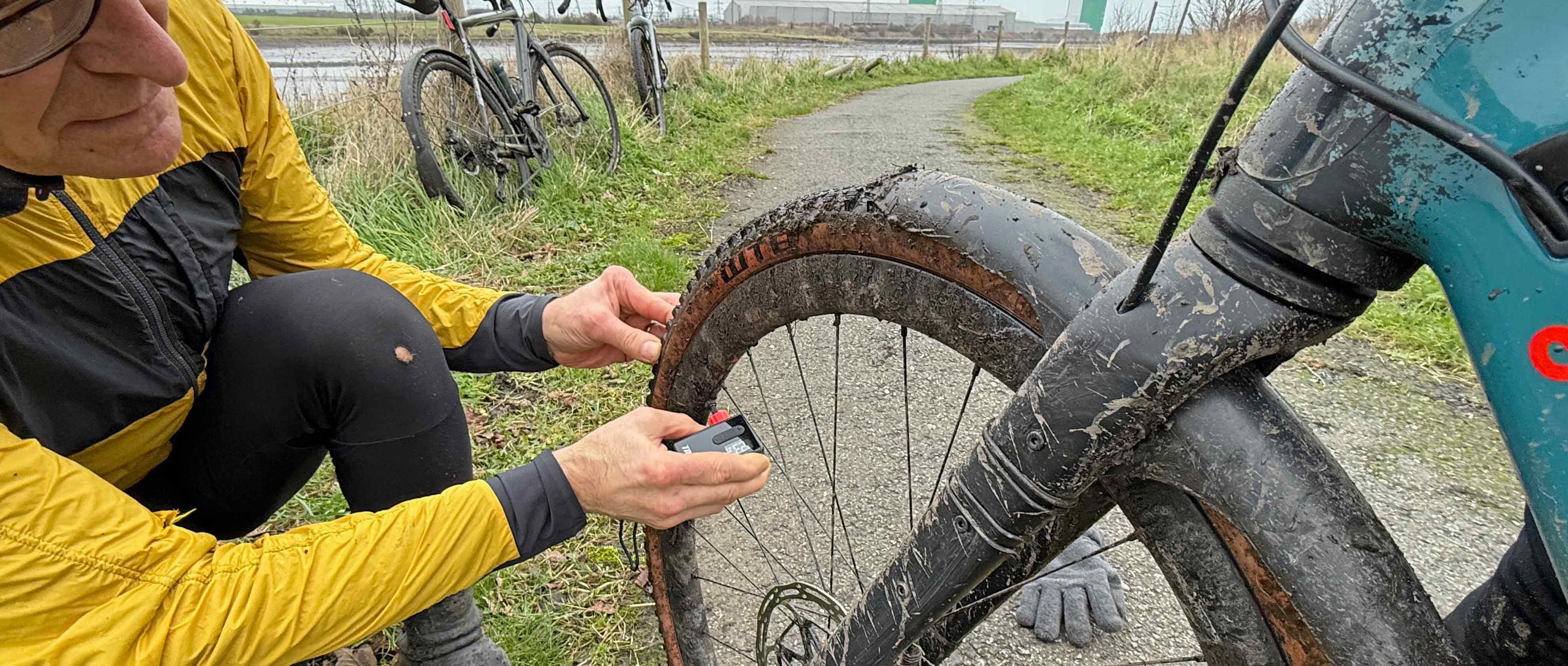
One particular benefit I hadn’t really anticipated was the fact that fixing a flat tyre mid-ride, when you’re tired, wet and getting increasingly cold is a much quicker and cleaner experience, assuming a quick trye plug fixes the hole from the outside. Taking the TruFlo pump out of my pocket and inflating a tyre is so much cleaner than dealing with a wet, muddy pump that’s strapped to the bike and you also don’t have to waste any energy pumping up the tyre!
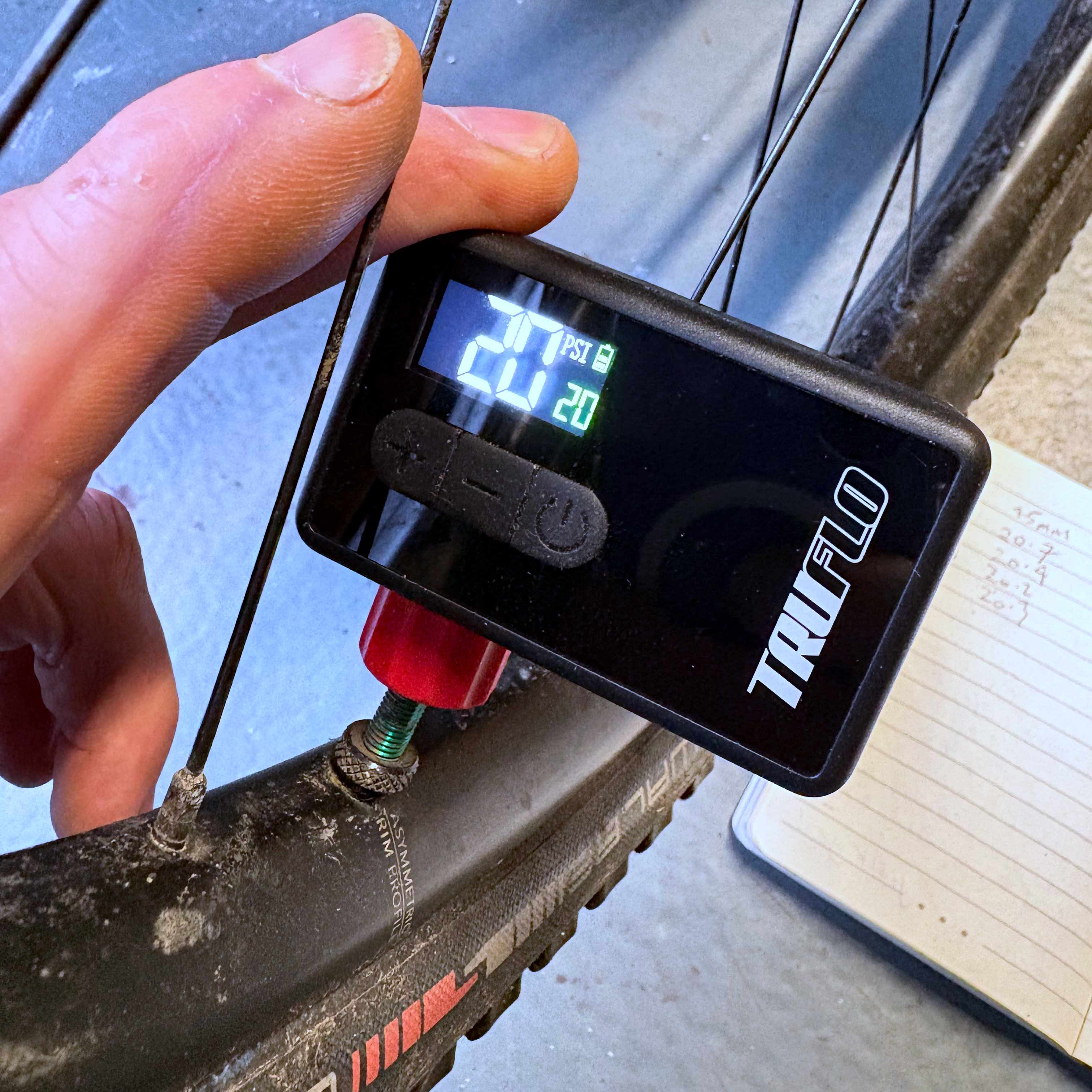
Tubeless tyres tend to deflate slowly over time and my normal pre-ride routine is to grab the track pump to top up the air, then, as the track pump gauge is so inaccurate, I use my digital pressure gauge and progressively let out air until I get to the right pressure. This is one of those jobs that is pretty tiresome, especially at stupid O’clock, when you’ve agreed to meet your mates somewhere and you just want to jump on the bike and go. I can now just set the pressure on the TruFlo pump and it’s a very simple one-button job. A niche benefit that was mockingly called out when I was using it once was that the absence of hand pumping would eliminate any muscle bulk I could be developing while using a regular pump, to the benefit of my cycling performance. I’ll leave that to you to judge whether that is an advantage or not!
The only real downsides I can see are that I still need to take a CO2 cartridge for those rare occasions when a tyre becomes unseated from a rim and needs a burst of quick pressure to re-seat it. There’s also the fact that the TruFlo now joins an ever-growing line of electrical equipment that needs to be charged before riding. I already need to charge my bike computer, front and rear lights and HR monitor, so it isn’t too much of an extra faff to add this.
At the end of the testing period, I would thoroughly recommend the TruFlo to anyone currently carrying a conventional mechanical pump on their rides. It is a much overused phrase, but I think this pump is truly a ‘game-changer’.
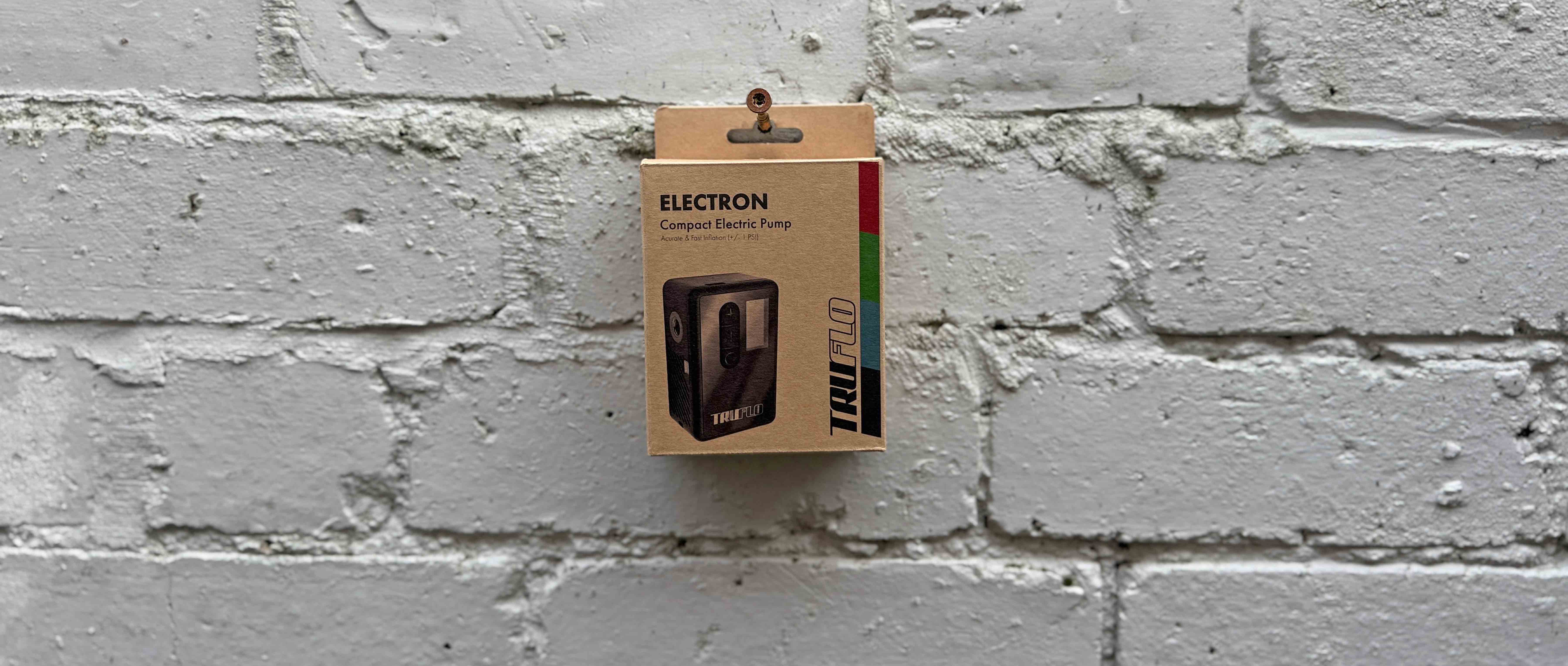
The TruFlo Electron Compact Electric Pump retails for £49.99. You can find out all the details on the Freewheel website.