Gravel riding might not be the most accurate term for the sport that we love. While most rides may include some sections of “true gravel”, it’s likely that the terrain we encounter off-road is often far rougher. From rutted farm tracks and exposed tree roots to cracked tarmac, loose stones, cobbles and potholes, a typical route can include a wide mix of uneven surfaces. All of these add up to one thing - constant, unwanted vibration. If your rides tend to be rougher than utopian champagne gravel, Olly reckons that USE’s VYBE suspension stem could be exactly what you need.
The riding shown in these photos is all within a short distance of Gravel Union Towers and are pretty typical of the kind of surfaces you might encounter on a normal “gravel” ride. Each lump of protruding sandstone bedrock, granite sett or chunk of crushed limestone will send vibrations up through your bike and into your body. If you’ve got the time/inclination, there is some interesting scientific research which looked at precisely what impact (pun intended) vibration had on a group of cyclists. The TL;DR summary was that “vibrations typically imposed in road cycling create varying mechanical stimuli on the entire musculoskeletal system. Muscular activation increased at the lower limb and hand–arm system, but not at the lower back. The demands on the cardiopulmonary and respiratory system increased slightly in the presence of vibration.” There were plenty of caveats in the research, but essentially riding on rough terrain required more muscle power, which needed a higher heart rate/breathing rate and used up more energy. So, if you can reduce the level of vibration reaching the rider, then the demands on the rider’s body are less and so the rider should feel fresher for longer.
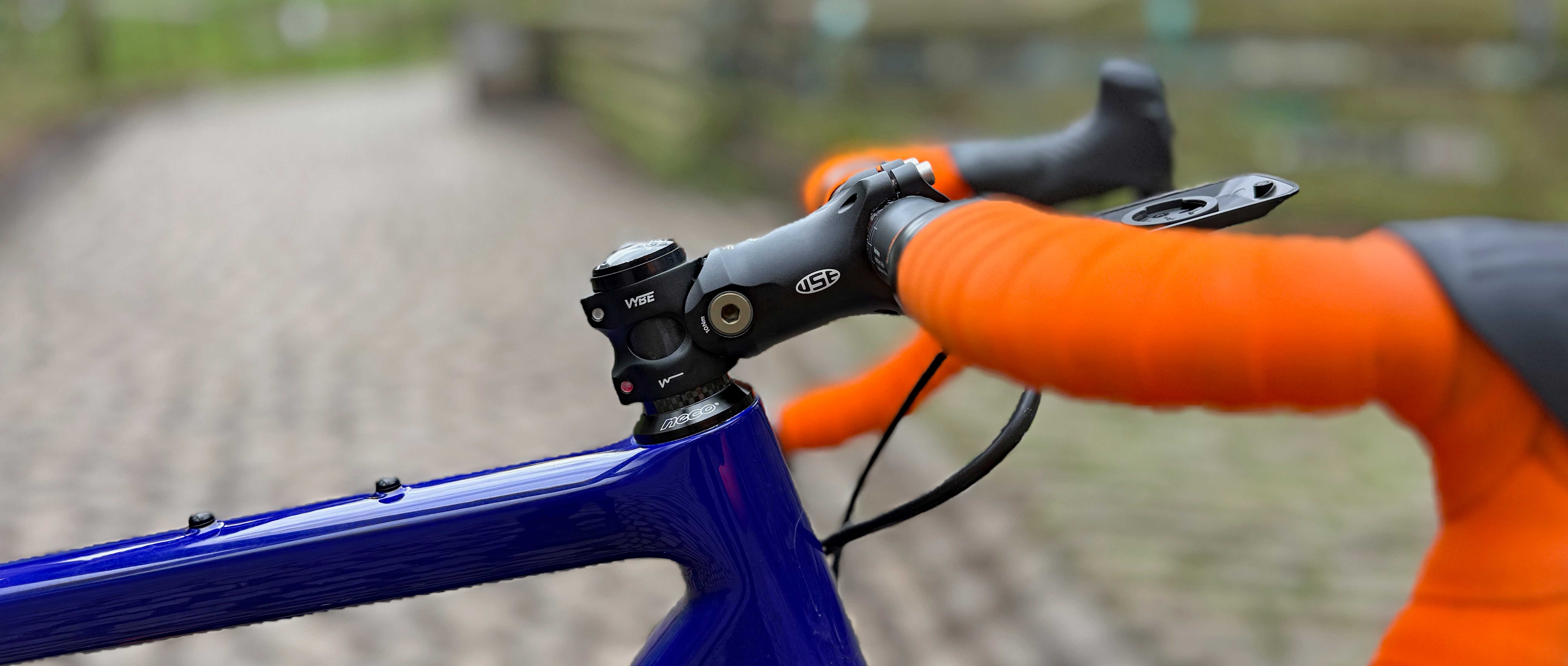
Those of you with grey hair or long memories, or both, might remember the mighty Girvin (née Offroad) Flexstem, which was launched way back in 1987 by creator Bob Girvin. The aim of the Flexstem was to ‘suspend’ mountain bikers from trail vibrations. It used a single pivot mechanism and a rubber elastomer to enable the riders’ handlebars to rotate downwards in an arc to absorb bumps. Although it had it flaws (limited damping, excessive twisting flex and high cost), it was launched in a period when suspension forks were as rare as rocking horse poo and the Flexstem offered a simple, low-maintenance way of making your ride somewhat more comfortable. Skip on quite a few decades to October 2024 and British engineering firm USE launched a thoroughly modern version of the Flexstem with their VYBE Suspension stem. Will it perform better than its ancient predecessor? That’s what I intended to find out.
The VYBE suspension stem comes in two length options (70mm and 90mm) and is designed for 1 1/8” steerer tubes and 31.8mm diameter handlebars. The stem has a 6 degree upwards angle and it can’t be fitted upside down (so anyone looking to reduce the height of their handlebars, you’re out of luck.) The stem comes with four different compression elastomers – blue (super soft), green (soft), yellow (medium) and purple (hard) and one non-changeable rebound elastomer. The comprehensive user guide that you can download to accompany the VYBE stem gives an overview of which elastomer USE recommend using for different combinations of stem length, rider weight and the type of handlebars you will be using. The VYBE stem comes pre-installed with a yellow compression elastomer and that gelled perfectly with USE’s recommendation for my combination of stem length (90cm), rider weight (64kg) and bar type (road bike style). My 90mm VYBE stem weighed in at 205g – a mere 68g more than the rigid stem I had previously fitted to my gravel bike.
As well as being able to change the compression elastomer (a five/ten minute job that most home mechanics should be able to do), you can make smaller, incremental adjustments to the rate of compression (how rapidly the stem moves downwards to absorb impacts) and rebound (how fast the stem returns to the ‘normal’ position after absorbing the shock) using a 3mm Allen key. Again, the VYBE user guide gives recommended amounts of compression and rebound adjustment for different weights of rider, lengths of stem and types of bars used.
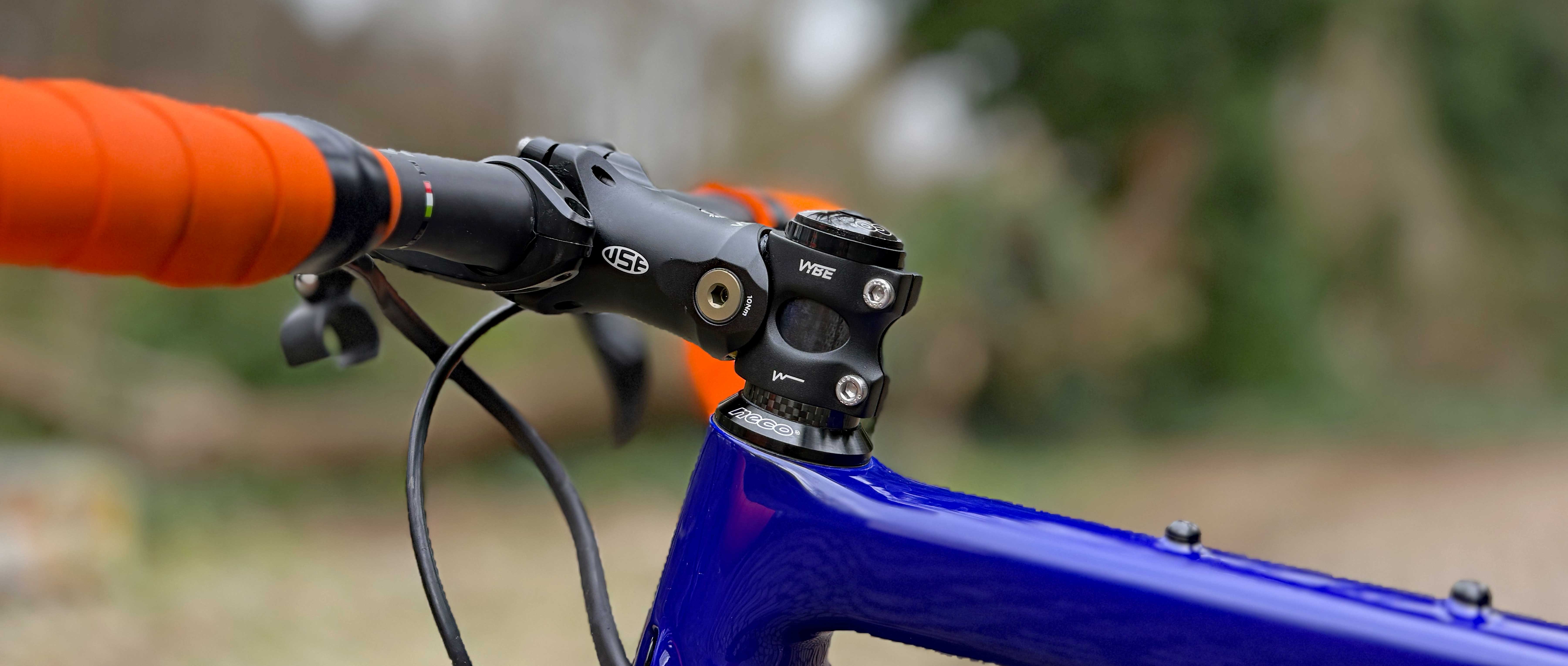
If my experience is anything to go by, the first thing you will do once you have correctly fitted the VYBE stem to your gravel bike is to hold on to your shifter hoods, push down hard and then be extremely surprised by how soft the ‘factory setting’ feels and how much the bars seem to move. This ‘carpark testing’ will at least show that the VYBE stem is functioning as it is designed, but luckily isn’t representative of how the stem feels once you’ve got it dialled in properly.
For my first test, I torqued all the bolts up to the correct tension, wound on two turns of compression and rebound damping, left the compression elastomer as the factory-fitted yellow (medium) and headed out in search of some hideous trails to test it out on. As a former industrialised city, Newcastle upon Tyne has an impressive array of ancient cobbled streets and so I planned a test route which included the worst ones that I could find. I realised very quickly that I had the stem set up too soft. The whole point of any form of suspension is that it moves to absorb the impact, but it’s a fine balance between moving enough to suspend the rider, but not moving unnecessarily so that you’re wasting energy. At different points during the ride, I increased the tension on the compression and rebound dampers until I reached what, for me, was the Goldilocks setting – five complete turns of rebound and four complete turns of compression damping. In combination with the stock yellow elastomer, it seemed to offer enough movement to soak up the trail imperfections, but not so much that my handlebars bobbed constantly when I was doing out of the saddle ‘efforts’ or was climbing.
What you will notice is that unless you use a significantly stiffer elastomer (at which point you pretty much negate the benefit of having the VYBE stem fitted), you will still get noticeable ‘dive’ when you brake hard. It’s not all that surprising – if you’re using your brakes from the hoods, your weight is as far forward on the bike as it’s likely to get. When you brake hard, your weight shifts even further forward thanks to momentum and as you ‘load’ the VYBE stem, so it moves through its 20mm of travel. Initially, it feels a little unnerving - it has the effect of lengthening your bike and lowering your hands closer to the ground, but I was surprised how quickly I adapted to it.
Depending on how gnarly you like your flavour of gravel riding, you might regularly encounter steeper descents or obstacles such as steps – I know I do! The first time you try riding down something which is steep, you will again notice the brake dive. As long as you remember to keep your head up and to shift your weight slightly further back on the bike, you won’t suffer any deleterious effects at all. In fact, the suspension action of the VYBE stem moving will soften the impacts your upper body is being subjected too and you should find that you end up at the bottom of the descent less battered than you would have done with a rigid stem fitted to your gravel bike.
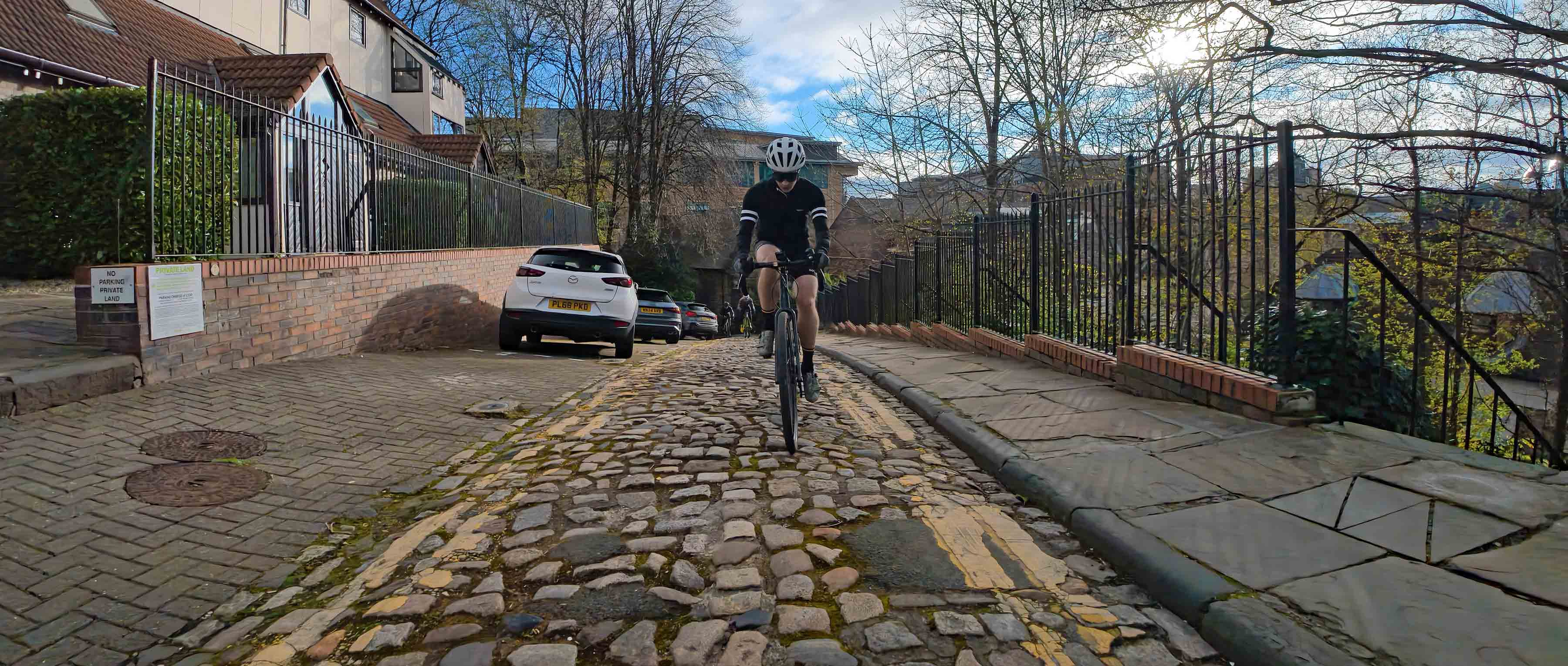
In stark contrast to the handlebar dive you might expect on steep descents or under heavy braking, the bike showed a clear absence of unwanted movement when climbing or sprinting. I initially expected some noticeable “bob” when riding out of the saddle, but that hasn’t been the case at all. Throughout the testing period, I repeatedly tackled some of Newcastle’s toughest cobbled climbs and I’ve been really impressed by how stable the bike felt. There was no unwanted bob and no noticeable lateral or twisting flex. Heavier or more powerful riders might experience more movement, but for me as a relatively lightweight rider (64kg), the VYBE stem performed flawlessly when climbing and sprinting.
You might be wondering whether fitting bigger volume tyres to your gravel bike would offer more benefit than fitting a VYBE stem? A gravel bike fitted with big volume, low tread tyres, set up tubeless and run at low pressure, will undoubtedly offer you an all-round better ride quality than just fitting a VYBE stem alone, but not all of us have the luxury of being able to fit big volume (700x50mm or larger) tyres. Many bikes don’t have the capacity for tyres this big, or you might be running mudguards/fenders, which reduce your tyre capacity on a seasonal basis. For anyone in this situation, fitting a VYBE stem will make a world of difference.
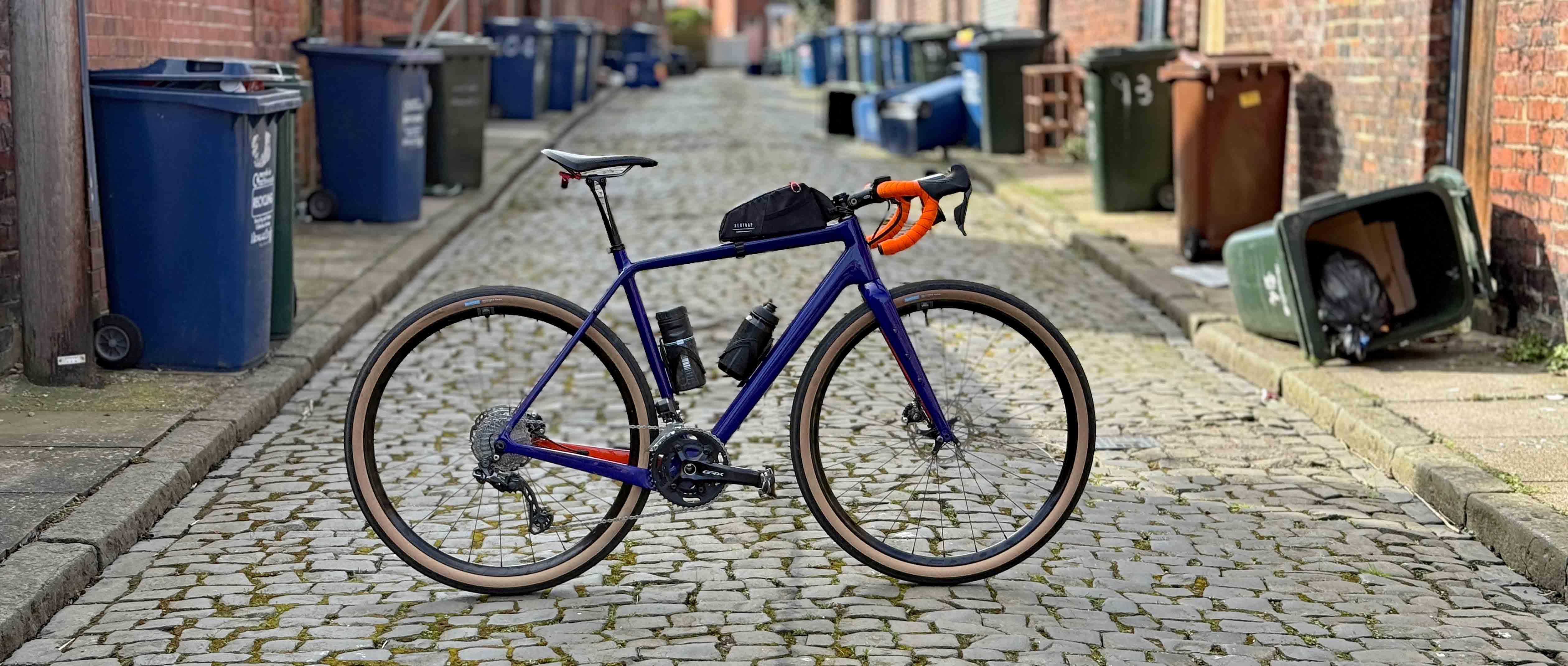
My long-term aim for using the USE VYBE stem was to try and make my gravel bike as cobble-friendly as possible. By the time this article is published, I will have tackled (hopefully) successfully, 170km of northern France’s gnarliest riding in the 2026 Paris Roubaix Challenge. No one sensible chooses to sign up for an event which includes more than 50km of cobbles, without making sure their bike (and body) is as well prepared as possible and this has certainly been the case for me. With a combination of the USE VYBE stem, 700x48mm slick tyres, suspension seatpost, super-comfy lightweight carbon handlebars and 3mm thick bar tape all fitted to the bike I'm going to be using for the event, I hope I’ve done as much as I can to smooth my arrival to the finish line.
Fitting a USE VYBE suspension stem to your gravel bike won’t offer you a 100% magic carpet ride over rough trails, but if you think of it in terms of cost-benefit, the VYBE stem offers a simple, low maintenance, light weight and minimal faff way of making your bike significantly more comfortable. If you’ve already made the other comfort upgrades to your bike (bigger tyres, flexible bars, thicker bar tape etc), then the VYBE stem is an absolute no-brainer. Hopefully, it will be the missing piece of the jigsaw to help me get to the finish line in Roubaix.
The USE VYBE stem is priced at £180.00 and is available direct from USE or from all good bike shops.