A few years ago, if you suffered a mid-ride puncture and needed to reinflate your tubeless tyre or inner tube, there were really only two options: reach for a mini pump if you were out on a day ride or multi-day adventure, or grab a CO₂ cartridge and inflator head if you were racing and every second counted. Technology has moved on considerably in recent years, however, and an increasing number of riders are now leaving the traditional pump and CO₂ cartridge at home in favour of compact electronic pumps. Valerio Stuart has been putting Topeak’s E-BOOSTER DIGITAL Mini through its paces to find out whether this new approach to roadside inflation really delivers.
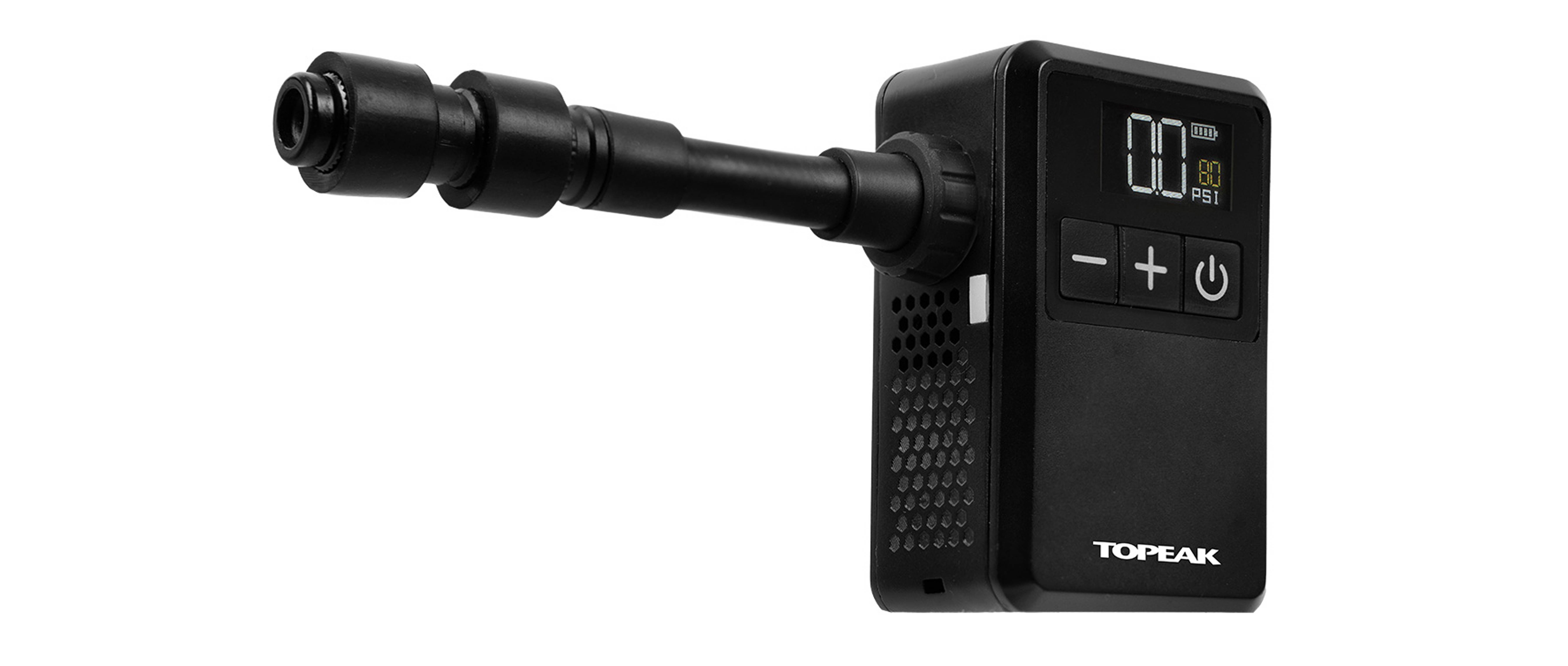
Image courtesy of Topeak
NB - A note before we start: while the Topeak E-BOOSTER DIGITAL mini was provided for this review, the Topeak Race Rocket MT Mini Pump, Topeak TubiBooster X, Topeak Joe Blow Track Pump also mentioned in this review were not. Topeak also offers a e-booster digital, the bigger brother of the “mini” reviewed here.
I've been using Topeak pumps for years, from a track pump to my trusty mini-pump which lives in my frame bag, and even an air chamber to deal with any stubborn tubeless tyre fitting issues. Having not tried an electric pump before, I was happy to jump on the opportunity to test one - more so as it was a Topeak pump.
Truly pocketable
The first thing that surprised me about the Topeak E-BOOSTER DIGITAL mini is how small it is. It’s genuinely pocketable, barely larger than an earphones case, at 5.4 x 3.2 x 7.2 cm. The e-booster is compatible with Presta, Schrader and Clik Valve systems, has a 500 mAh battery that charges via USB-C in around 45 minutes and can reach a pressure of 120psi (8 bar) while weighing just 120g.
It comes with an extension hose, which makes it easier to reach an awkward valve and stops the heat that the pump generates from damaging it (particularly important for anyone using superlight TPU tubes), plus a waterproof storage bag to protect the pump itself (the pump is not waterproof). It can also be used without the extension hose.
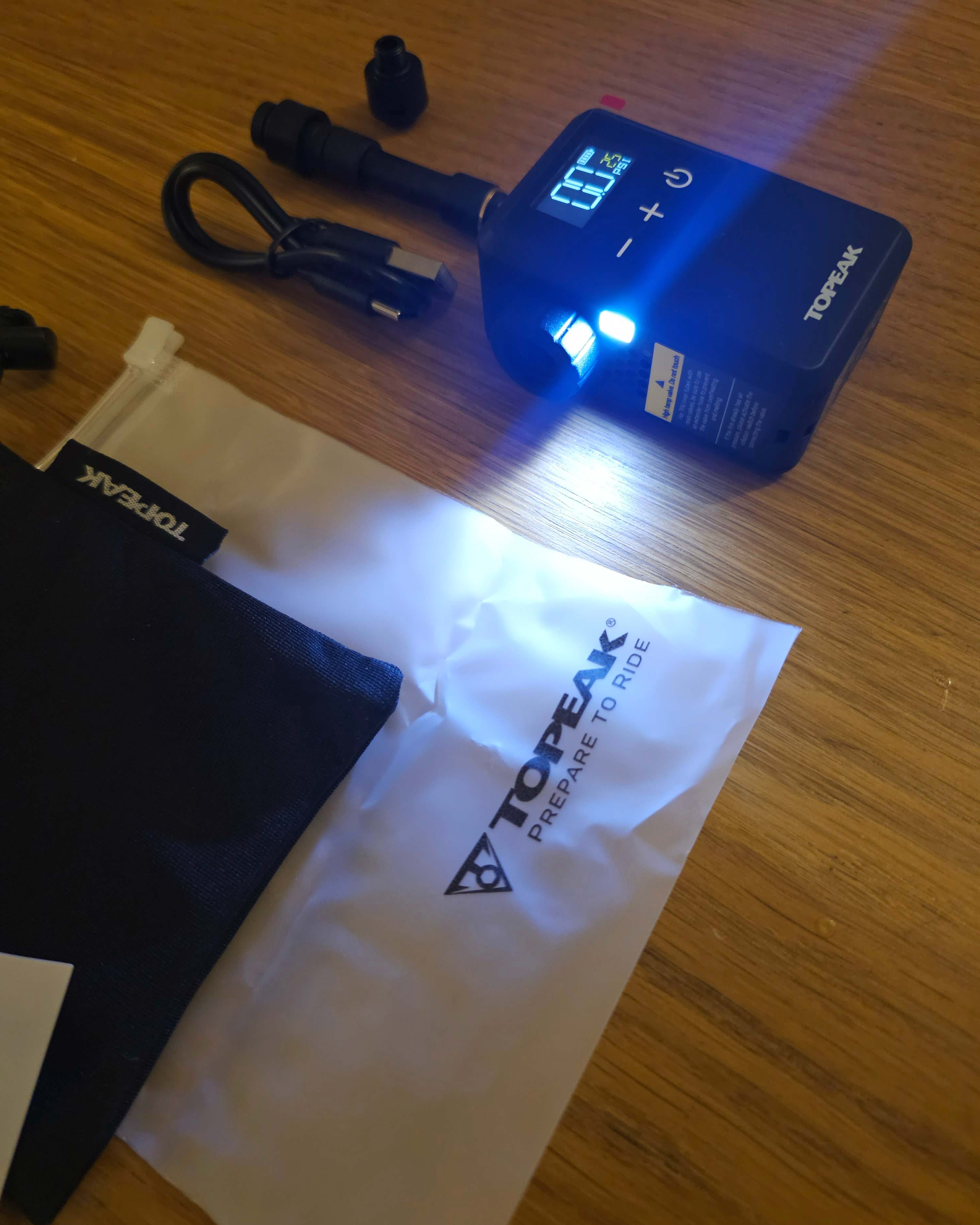
A nice touch is the small light on the side of the pump head, handy in an emergency or for operating the pump at night. The build quality feels solid: the screen is clear and the buttons are large enough to use easily. The pump is small, but not so small that it becomes fiddly for someone with moderately large hands. One thing worth flagging early: it’s noticeably louder than a regular pump while it’s running - think along the lines of a small drill, so it’s not exactly a discreet way to top up your tyres at a campsite at 6 am.
At £110 RRP, the pump isn’t cheap and it’s significantly more expensive than my Topeak Race Rocket mini (£40). Against other electric pumps, though, the price sits close to the average: the Prestaflator GO has a larger battery and retails at £100, while the Rockbros AS110 costs £80, albeit in a slightly larger unit.
How to use it
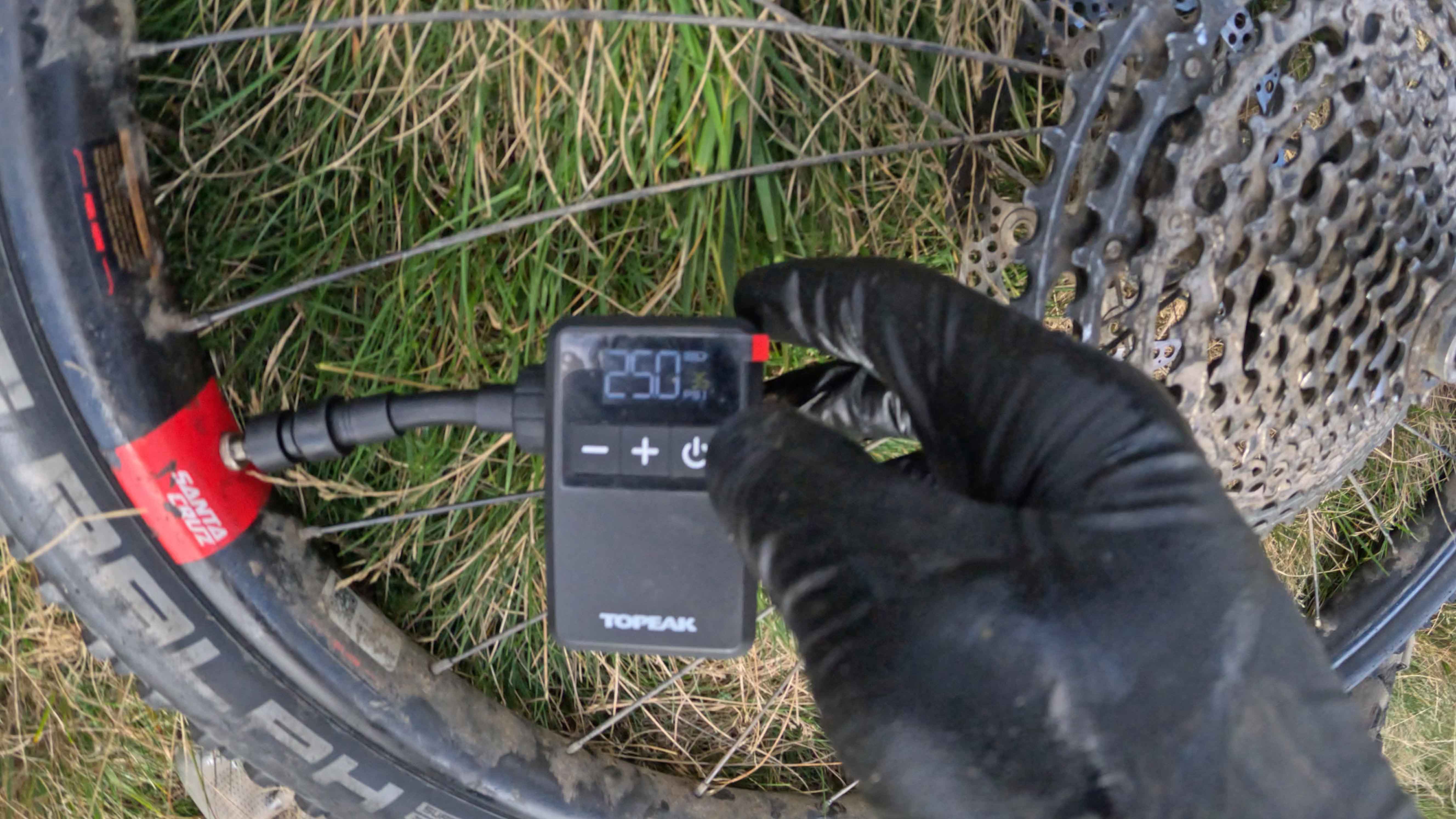
Using the pump is straightforward: a long press of the on/off button turns it on. The +/- buttons set the desired pressure, which the pump remembers for next time and pressing the on/off button starts inflation. The pump stops automatically once it reaches the target pressure. A long press of the on/off button turns the pump off, while a double press of the minus button toggles the light. To inflate a tyre, simply press the pump head onto the valve, or connect it via the extension hose and press the on button. That’s it.
How it performs at home
Topeak claims the e-booster mini can inflate a 700x50c tyre to 30psi five times on a single charge. I put that to the test on my gravel wheelset: a BeespokeWheels carbon rim (27mm internal width) with a Reserve Fillmore valve, shod with Schwalbe RS Pro tyres in 700x50c.
I deflated the tyre fully, inflated it to 30psi, turned the pump off and let it cool for a few minutes (it does get noticeably warm in use), then repeated the process. On the fifth attempt, the pump got the tyre to 23.6psi before stopping and telling me it had run out of battery. That’s close enough to Topeak’s claim and it confirms that in real-world use you’d get a lot more than five uses out of it: I tend to run lower pressures and the odds of running a tyre completely flat for five times are fairly low. After suffering five flat tyres, I don’t think I’d want to carry on with a ride regardless of which type/make of pump I was carrying.
Can it seat a tyre?
This was a genuinely interesting question for me. My Topeak Race Rocket Mini isn’t up to the job (I doubt many portable pumps are), so I was curious whether an electric pump could manage it. In my experience, unfortunately, the answer is no. Having unseated half the tyre completely, the e-booster mini simply didn’t have enough “oomph” to pop it back up. It might have managed with a helping hand, or with the mini pump assisting, but on its own it didn’t seem able to push enough air quickly enough to shift the tyre.
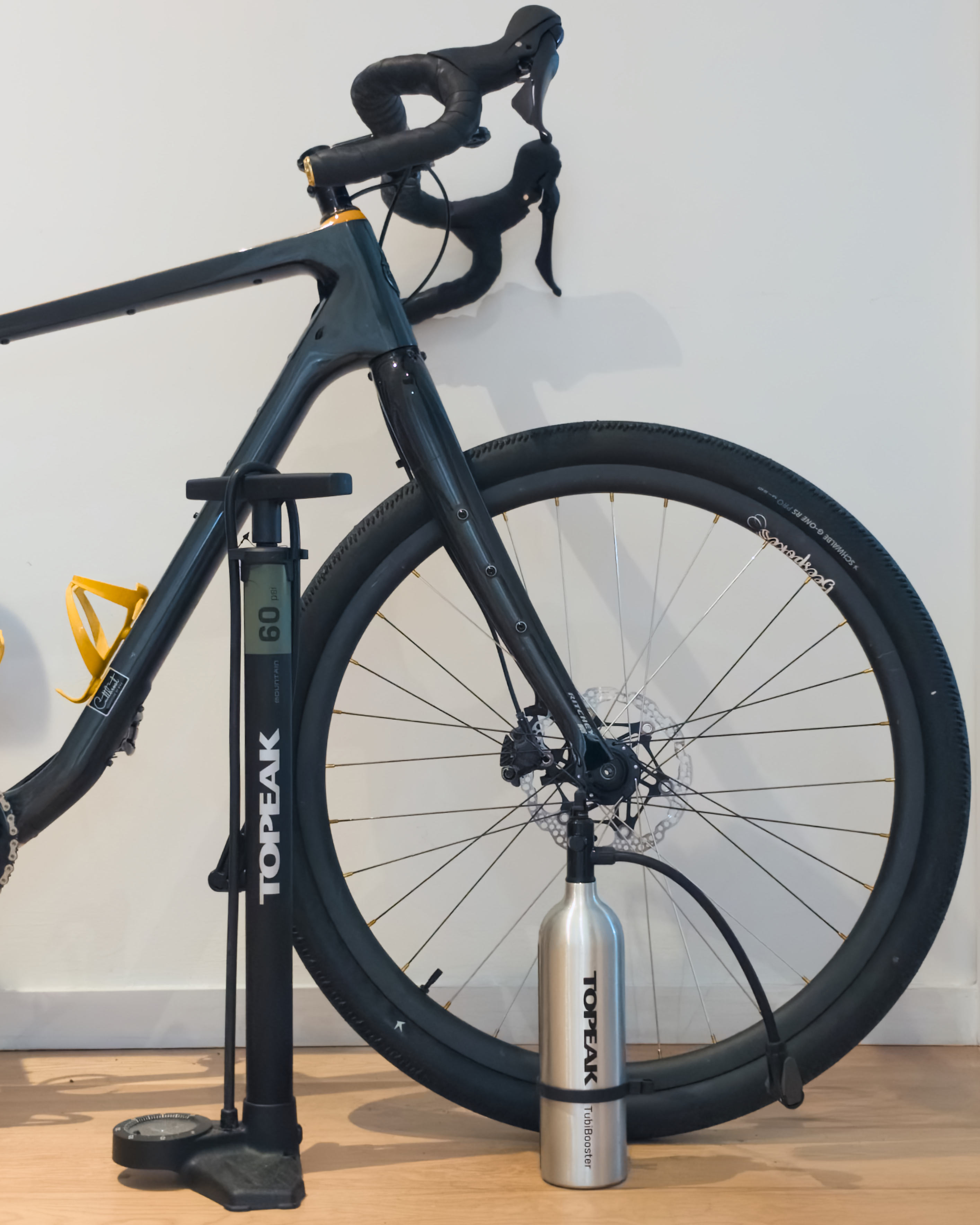
In comparison, the Joe Blow track pump made short work of it and I didn’t need to reach for the TubiBooster, which is my last resort for the most stubborn tyres.
How it performs in the field
After a puncture on my last ride, I finally got the chance to test the pump in the field. I’d used it at home, but a while back and had completely forgotten how it worked. It didn’t take long to remember and put it to use.
My tubeless system had failed completely, courtesy of a broken spoke that had punched through the tubeless tape, so I was fitting an inner tube to get home. With the tube totally flat and keen to save myself some swearing and huffing and puffing, I grabbed the e-booster, set the pressure to 25psi for my 2.35” tyres and connected the extension hose to the pump and valve.
In about 40 to 45 seconds, the tube was at 25 psi, and the tyre was up, though not yet seated properly on the rim. I quickly bumped the pressure to 35psi and restarted the pump: a few more seconds, a couple of pops and the tyre was seated. Not wanting to ride on a rock-hard rear tyre, I partially deflated it, reset the pump to 25psi and topped up the pressure. This used less than 25% of the pump’s battery, in line with Topeak’s average figures for a tyre this size.
Worth noting: I hadn’t used or charged the pump in a long time and it was still fully charged when I grabbed it: if you are concerned about forgetting to charge yet another device, this doesn’t seem to apply to this pump.
Comparison with other pumps
While the e-booster mini could easily become your go-to pump at home, it makes more sense as a portable option. If you’re the kind of rider who needs to know the exact pressure in your tyres, the Topeak e-booster mini could replace both a mini pump and a pressure gauge.
Bikepacking & gravel riding/racing
I’ve carried the e-booster with me on an overnighter and I wouldn’t hesitate to take it as my only pump for long rides or short multi-day trips, especially when riding with others, knowing I could borrow a pump from them as a failsafe should the electric one give up. For racing or gravel riding, the e-booster beats a traditional portable pump hands down, making inflation effortless and taking the guesswork out of tyre pressure.
For a genuinely quick top-up in a race, nothing beats a CO2 canister and that’s not really what the e-booster is designed for. But a canister only gives you one or two uses before you’re out and then you’re stuck. I see the two as complementary rather than one replacing the other: CO2 for the fastest possible fix mid-race, the e-booster for everything else, repeated punctures, a slow leak you want to nurse home, or simply not wanting to carry canisters at all.
For long multi-day trips, though, where reliability matters and access to power is uncertain, I’d still carry a traditional pump: one that won’t stop working if it gets wet or damp and also one that offers a limitless number of inflations. That said, if you’re running a dynamo hub, the battery anxiety largely disappears, since you can keep the e-booster topped up as you ride.
Pros
- Easy to use
- Pocketable
- Flexible extension hose prevents damage to valves
- Enough battery capacity for multiple inflations
Cons
- Not waterproof; needs its own protective bag if the weather turns
- Expensive compared with a traditional portable pump, though good online deals can be found well below RRP
- Loud, noticeably more so than a regular pump, closer to the whir of a small drill
The verdict so far
There’s a lot to like about this little pump. Getting a large-volume MTB tyre up in under a minute, while I munched some snacks and packed my other tools away, was genuinely satisfying and saved time and effort. For day rides, I think I’m sold and I’d happily swap my mini pump for it. For multi-day rides where access to power is scarce or wet weather is likely, I wouldn’t ditch my traditional pump completely; I’d probably look for an even more compact one to pair with the e-booster mini.
Also, although this won’t apply to everyone, if, like me, you use your pump to carry various types of tape for bodges and repairs in the field, you’ll need to find another solution: electric pump bodies are small and the USB and air ports need to stay unobstructed.
The Manufacturer’s Recommended retail price for the Topeak E-BOOSTER DIGITAL mini is £109.99 (or equivalent in local currency). You can find all the details here.